When an invasive fish is also tasty, Maryland schoolkids can help 'eat the problem'
0 / 111
English
中文
Invasive blue catfish are a problem in the Chesapeake Bay and its tributaries, preying on native seafood like the blue crab. To help keep them in check, local schoolchildren are eating catfish for lunch. Ryan Kellman/NPR hide caption PRESTON, Md. — It's lunchtime at Preston Elementary School, on Maryland's Eastern Shore.
(暂无翻译) (暂无翻译) (暂无翻译)
Kids file in, get dollops of food on their segmented trays, and maybe grab a chocolate milk. But one option on today's menu is special, served alongside grapes and broccoli. "I got a catfish sandwich!"
(暂无翻译) (暂无翻译) (暂无翻译)
announces Ben Rochon, a second-grader. Between mouthfuls, he tells me how it is: "It's yummy." He's eating a catfish cake, also known by its nickname, the "catty patty."
(暂无翻译) (暂无翻译) (暂无翻译)
Some kids like it with ketchup or mayo. Fifth-grader Teagan Donovan goes minimal. "I like it by itself with no toppings, because it's pretty good by itself," she says.
(暂无翻译) (暂无翻译) (暂无翻译)
In Teagan's case, "by itself" is literal: "I ignore the bun." At Preston Elementary School on Maryland's Eastern Shore, catfish sandwiches are a highlight of a local food initiative.
(暂无翻译) (暂无翻译)
Ryan Kellman/NPR hide caption Not everyone's into the fish cake — after all, this sunny Friday is also pizza day at Preston, and cheese slices are tough competition. But more kids have been trying catfish when it's served a couple of times a month.
(暂无翻译) (暂无翻译)
That's good news to Beth Brewster, who oversees food services for Caroline County Public Schools. "It tastes great. It's great for you," she says of the fish cake.
(暂无翻译) (暂无翻译) (暂无翻译)
It has another benefit: It's made with blue catfish. Since spreading to the Chesapeake Bay in recent decades, the fish has become an apex predator.
(暂无翻译) (暂无翻译)
It can grow to more than 100 pounds; its voracious appetite is fueling worries that it's eating too many native species. "It tastes so good because it eats everything we love — crabs and rockfish, and all kinds of things that we love to eat," Brewster says. Beth Brewster led her chefs in developing a catfish cake known as the "catty patty."
(暂无翻译) (暂无翻译) (暂无翻译)
Brewster is the supervisor of food services for Caroline County Public Schools.
(暂无翻译)
Ryan Kellman/NPR hide caption State officials first asked Brewster to help tackle this problem about eight years ago. "I was like, 'Beth, we have this invasive species. It tastes pretty good, is what we've been hearing.
(暂无翻译) (暂无翻译) (暂无翻译)
Can you do something about it?'" says Karen Fedor, administrator of the Farm and Food Programs at the Maryland Department of Agriculture.
(暂无翻译)
Fedor describes Brewster as an "out-of-the-box thinker" who'd be up for the challenge of experimenting with recipes that appeal to kids — and also conform with federal dietary requirements. That's how Brewster's team landed on a crabcake-like dish made of blue catfish. "It was kind of fun for my chefs to play with the recipe," she says, adding that because they have USDA approval, the cakes can be served anywhere in the U.S.
(暂无翻译) (暂无翻译) (暂无翻译)
The pandemic initially slowed the effort down, Brewster says. But then she heard that Virginia was partnering with a California-based program called Bay2Tray to connect seafood with schools.
(暂无翻译) (暂无翻译)
Brewster got in touch with a simple message: "I have a fish for you."
(暂无翻译)
Now, other school districts in both Maryland and Virginia are serving blue catfish. In Preston, a rural community near the Choptank River, kids are excited to do their part by chowing down on the catty patty. "It kind of tastes like crabs, but in a fish way," says fifth-grader Raelynn Truitt.
(暂无翻译) (暂无翻译) (暂无翻译)
"It's like, really really good." Fifth-grader Teagan Donovan, at left, doesn't go for ketchup, mustard or mayo on her catfish sandwich.
(暂无翻译) (暂无翻译)
Classmate Raelynn Truitt is also a fan: "It kind of tastes like crabs, but in a fish way," she says. Ryan Kellman/NPR hide caption To Brewster, the blue catfish presents a bad news-good news proposition.
(暂无翻译) (暂无翻译)
It's invasive — and its white, flaky meat is tasty, in part because it's not a bottom feeder. It was first brought to rivers in Virginia in the 1970s for recreational fishing. "Blue catfish are a large freshwater catfish native to the Midwest," says Branson Williams, manager of the Invasive Fishes Program for the Maryland Department of Natural Resources.
(暂无翻译) (暂无翻译) (暂无翻译)
The idea, he says, was that people would catch the fish in a few rivers feeding into the Chesapeake. But brackish water in the bay would keep them from spreading. "They're a freshwater fish; they should stay in those freshwater portions of the river," Williams says.
(暂无翻译) (暂无翻译) (暂无翻译)
But, it turns out, "they can handle some salinity."
(暂无翻译)
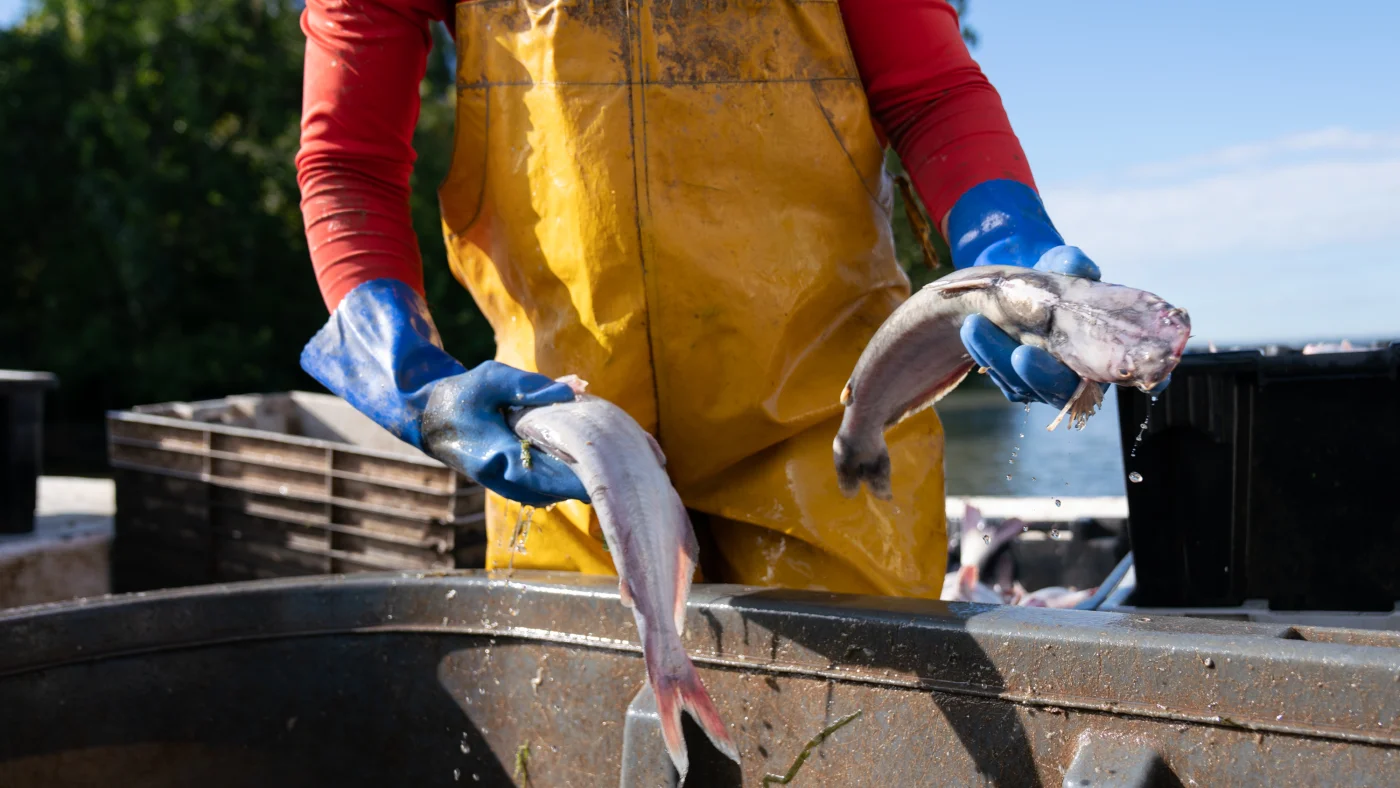
Zach Swann sorts through the day's catch of blue catfish at a dock on the lower Potomac River. The species was first brought to rivers in Virginia in the 1970s for recreational fishing.
(暂无翻译) (暂无翻译)
It's spread to every tidal tributary of the Chesapeake Bay in Maryland. Ryan Kellman/NPR hide caption You could even say those officials got catfished.
(暂无翻译) (暂无翻译)
Because in 2018, when Virginia and Maryland had record rainfall, the blue catfish used all that fresh water to leave those rivers and find new habitats. "They now occur in every tidal tributary of Maryland. They occur in the Chesapeake Bay proper," Williams says. In some spots, blue catfish make up about 70% of the fish biomass, or total weight, Williams says.
(暂无翻译) (暂无翻译) (暂无翻译) (暂无翻译)
Virginia officials have also been raising the alarm, saying the fish is out of control and threatening the seafood industry that relies on traditional species such as flounder. Blue catfish reproduce quickly and eat important forage fish like menhaden.
(暂无翻译) (暂无翻译)
They also gobble up young crabs and fish, adding to stress on those populations. If the Chesapeake Bay has fewer blue crabs, it would be a huge economic and cultural blow to Maryland.
(暂无翻译) (暂无翻译)
So the state is turning to the only predator the blue catfish really has: people. It joins other states trying to tap humans' role as apex predators to combat invasive species.
(暂无翻译) (暂无翻译)
They include Kentucky and Illinois targeting the Asian carp, and Maine and Washington state's battle against invasive green crabs. Rocky Rice likes to average at least 1,200 pounds of blue catfish on each outing on the lower Potomac River.
(暂无翻译) (暂无翻译)
The invasive fish is now his primary target. Ryan Kellman/NPR hide caption On a recent sunny morning on the lower Potomac River, Rocky Rice is bringing his catch back to the dock.
(暂无翻译) (暂无翻译)
He's a fourth-generation Maryland waterman. But instead of crabs, his boat is full of blue catfish.
(暂无翻译) (暂无翻译)
He tosses them into ice tubs, sorting them by size. "Right at a thousand," he says, as he slings a fat catfish into a crowded tub. "It's usually about a hundred pounds to a tub."
(暂无翻译) (暂无翻译) (暂无翻译)
That's actually a little light. Rice wants to average about 1,200 to 1,500 pounds. He goes out three days a week, pulling catfish from hoop pots that trap them in their nets. Rice, at right, and Swann, his first mate, sort blue catfish by size and weight.
(暂无翻译) (暂无翻译) (暂无翻译) (暂无翻译)
Rice says the fish doesn't bring the high prices of some other seafood, but it provides a steady income for his small operation. Ryan Kellman/NPR hide caption He started fishing for blue catfish 14 years ago to stay busy when he wasn't crabbing.
(暂无翻译) (暂无翻译)
Now that's all flipped around. The market for blue catfish doesn't bring the high prices of other seafood, but Rice says the market and steady volume of his catch are strong enough to sustain his small operation. "What I started off as just something to do to fill in, in between other seasons, actually has turned into my primary job now."
(暂无翻译) (暂无翻译) (暂无翻译)
And Rice can fish for blue catfish year-round. Because they're invasive, there is no season or size limit. "You can catch as many of them as you want," says Maryland Department of Natural Resources' Williams.
(暂无翻译) (暂无翻译) (暂无翻译)
"And you don't have to throw the little ones back.
(暂无翻译)
Please keep them all." Before we leave the dock, I ask Rice if he eats blue catfish himself. "Oh yeah!" he answers.
(暂无翻译) (暂无翻译)
"They're good.
(暂无翻译)
It's a snow white, mild fillet." The lack of a "fishy" flavor means blue catfish is good for fish tacos, Rice says.
(暂无翻译) (暂无翻译)
But he has his own preference: "You know, I'm from the country. So, if we can, we want to deep-fry everything, like nuggets and fried fillets." Students at Preston Elementary select their lunches, including a catfish cake sandwich.
(暂无翻译) (暂无翻译) (暂无翻译)
On a recent visit, the school also offered fillets.
(暂无翻译)
Ryan Kellman/NPR hide caption By early afternoon, Rice's catch will be on its way to a processor. And that's where things hit a bit of a bottleneck. Catfish is the only U.S. fish that's required to have a USDA inspection.
(暂无翻译) (暂无翻译) (暂无翻译)
The rule is meant to protect the U.S. market from cheap imports. But it takes money and time for a seafood processor to have a USDA inspector on site. As a result, only four processors in Maryland are able to handle processing blue catfish, according to Williams — even with grants and other help.
(暂无翻译) (暂无翻译) (暂无翻译)
Still, the fish is making its way to grocery stores and restaurants around the country; in Maryland, it's also in schools and food banks. After all, it's an affordable protein that comes from a sustainable fish. That makes it a good fit for Bay2Tray, which focuses on developing new markets for bycatch and invasive fish.
(暂无翻译) (暂无翻译) (暂无翻译)
"Just yesterday, I shipped a pallet of the blue catfish to a university in Texas," says Jenn Lovewell, chief nutrition officer for Real Good Fish, the company that runs Bay2Tray. Rice secures his boat before heading back to his fish house in Maryland. Ryan Kellman/NPR hide caption Both Lovewell and Brewster, the school official, say millions of pounds of the fish need to be harvested, just to maintain the status quo.
(暂无翻译) (暂无翻译) (暂无翻译)
"It'll never be eradicated," says Brewster. So she urges people to seek out the fish in markets and restaurants. Or as Lovewell puts it, "Eat the problem and save the bay."
(暂无翻译) (暂无翻译) (暂无翻译)
Newly harvested blue catfish are quickly put on ice, ready to be sent to a seafood processor. Ryan Kellman/NPR hide caption
(暂无翻译) (暂无翻译)
仅供学习使用,如有侵权请联系删除 · 查看原文