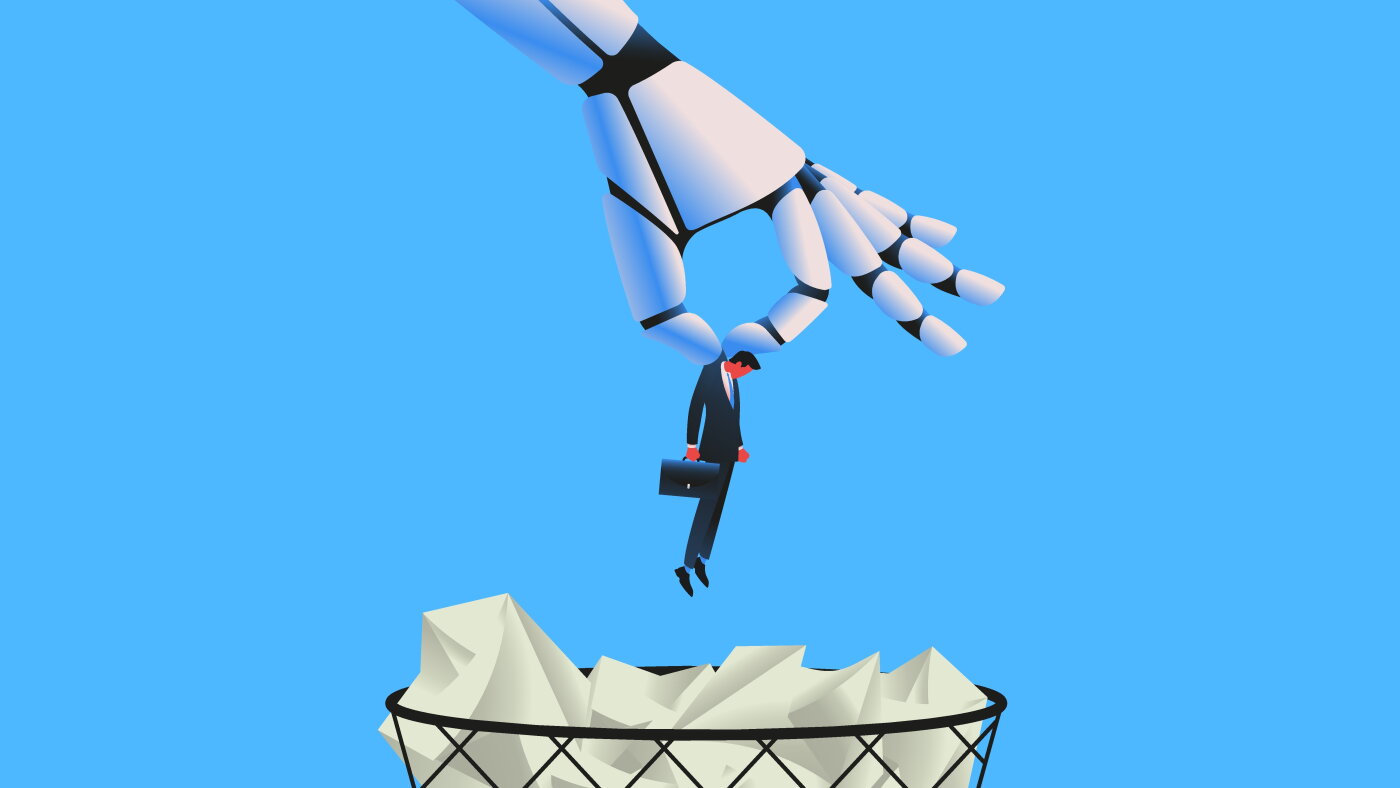
What if an AI bubble bursts — and that accelerates AI job losses?
0 / 70
English
中文
This article first appeared in the Planet Money newsletter. You can sign up here.
(暂无翻译) (暂无翻译)
What if an AI bubble bursts, triggering a recession, and that recession ends up accelerating the replacement of workers with AI? Call it the AI double whammy.
(暂无翻译) (暂无翻译)
I've long been skeptical of sweeping claims about how AI will transform the world. I still am. We don't really know. But as this technology advances, I've found myself worrying more about what it could mean for our livelihoods.
(暂无翻译) (暂无翻译) (暂无翻译)
Two strands of economic research have given me reason to take this double whammy seriously. One concerns the history of financial bubbles. The other concerns a surprising relationship between recessions and automation, when businesses use technology to do tasks that were previously done by humans.
(暂无翻译) (暂无翻译) (暂无翻译)
First, the bubbles. In 1978, the economist Charles Kindleberger published an influential book titled Manias, Panics, and Crashes: A History of Financial Crises. Drawing on the theoretical work of economist Hyman Minsky, Kindleberger went through centuries of economic history and saw a recurring pattern.
(暂无翻译) (暂无翻译) (暂无翻译)
Often the bubble starts with some big potential change to the economy. A revolutionary new technology, for example, that promises to transform industries and create enormous wealth. Investors have a good reason to be excited by it. But they get overly excited. During the upswing, they bet tons of money expecting basically that the sky is the limit. And they often build up debt in the process, borrowing money to make even bigger bets and thereby helping to further fuel the boom. That debt can become a ticking time bomb. When reality sets in, asset prices fall, but those debts remain. Borrowers struggle to repay, lenders suffer losses, and a market crash can spiral into a financial crisis and a painful recession.
(暂无翻译) (暂无翻译) (暂无翻译) (暂无翻译) (暂无翻译) (暂无翻译) (暂无翻译) (暂无翻译) (暂无翻译)
One crucial insight is that a technology can truly be revolutionary, yet still fuel a bubble that ends in a financial crash. For example, the railroads. I wrote about that bubble in a previous Planet Money newsletter — and how its collapse triggered "The Panic of 1873." The ensuing economic turmoil helped foment a populist uprising and the first major immigration crackdown in American history.
(暂无翻译) (暂无翻译) (暂无翻译) (暂无翻译)
AI is now basically propping up the U.S. stock market. An analysis from J.P. Morgan earlier this month found that just 42 AI-related companies accounted for around two-thirds of the S&P 500's stock price gains since early 2024. Meanwhile, AI-related companies are borrowing hundreds of billions of dollars to help finance data centers and the energy infrastructure to power them.
(暂无翻译) (暂无翻译) (暂无翻译) (暂无翻译)
None of this proves that what we're witnessing is a bubble or that this debt is a ticking time bomb for the financial system. The bursting of the dot-com bubble helped usher in a relatively mild recession. Debt played a smaller role in that boom, helping to limit the financial fallout. Its collapse did not trigger a systemic financial crisis like the one that followed the housing market bust around 2008.
(暂无翻译) (暂无翻译) (暂无翻译) (暂无翻译)
Even without a financial crisis, though, there could be a painful reckoning. Will all these companies ultimately make enough money to justify all their borrowing and spending? Will each company survive? Technology analyst Benedict Evans has warned that fierce competition between companies offering similarly capable AI models could drive down the prices they can charge and leave little room for profit — even as they're spending ungodly amounts of money to develop and run these models.
(暂无翻译) (暂无翻译) (暂无翻译) (暂无翻译)
If an AI bust triggers a recession, that would be painful enough. But this is where a few studies add to my anxieties. Because they suggest that recessions can be the very moment when businesses turn to new technologies to replace workers.
(暂无翻译) (暂无翻译) (暂无翻译)
We tend to imagine automation as a gradual process. Technology improves, businesses adopt it, and jobs slowly change or disappear, theoretically while new jobs appear in other parts of the economy. But this research suggests that automation can happen in bursts, and those bursts tend to cluster around recessions.
(暂无翻译) (暂无翻译) (暂无翻译)
One study, by economists Nir Jaimovich and Henry Siu, found that jobs vulnerable to previous waves of automation saw most of their decline around recessions. Between 1990 and 2017, 88% of the decline in the share of Americans employed in these jobs occurred during recessions or in the months immediately before or after them.
(暂无翻译) (暂无翻译)
And here's the unsettling irony: fierce price competition could keep AI companies from delivering the profits investors expect, while making their technology cheaper for other businesses to use to replace workers. If an AI bust triggers a recession, that downturn could accelerate worker replacement. Investors could lose their money, and workers could still lose their jobs.
(暂无翻译) (暂无翻译) (暂无翻译)
It's a nightmare scenario. First, the bust hammers our retirement savings. Then, as businesses scramble to cut costs, many of our jobs are permanently lost.
(暂无翻译) (暂无翻译) (暂无翻译)
Of course, we still don't know whether AI will deliver enough profits to justify all the borrowing and spending, whether a bust would trigger a painful recession, or whether the automation patterns found in past recessions will repeat themselves with AI. A downturn could leave businesses with less money to invest in AI. And AI could still prove more useful for helping workers get more productive than outright replacing them.
(暂无翻译) (暂无翻译) (暂无翻译)
Whether AI delivers one whammy or two whammies or none, there are policies that can limit the damage when workers lose their jobs. Obviously, unemployment insurance and other policies like that. And people like Bill Gates are proposing that we should tax AI and robots, making it more economical to continue employing humans while generating revenue that the government can spend to enhance the safety net. That idea is something we might explore in a future newsletter.
(暂无翻译) (暂无翻译) (暂无翻译) (暂无翻译)
So, yeah, there are reasons this nightmare might never come true, and there are ways to limit the damage if it does. That, however, hasn't stopped me from worrying about it.
(暂无翻译) (暂无翻译)
But it felt cathartic writing this down — getting these worries out of my head and onto the page.
(暂无翻译)
LIVE VIRTUAL EVENT FOR NPR+ SUPPORTERS Wondering what AI could mean for your livelihood? Join Adrian Ma from The Indicator from Planet Money on Wednesday, October 28, for a virtual "Ask an Economist" event about AI and jobs. It will feature Daron Acemoglu, a Nobel Prize-winning professor at MIT, and Erik Brynjolfsson, a professor at Stanford and director of the Stanford Digital Economy Lab. During the event, we'll invite you to share your thoughts and ask questions! This is for our NPR+ supporters, join here, and find more details on the event here. P.S.
(暂无翻译) (暂无翻译) (暂无翻译) (暂无翻译) (暂无翻译)
Charles Kindleberger's life was super fascinating. As we've written before, he worked for the CIA's wartime predecessor and helped design the Marshall Plan. Someone should probably make a Hollywood movie about him.
(暂无翻译) (暂无翻译) (暂无翻译)
仅供学习使用,如有侵权请联系删除 · 查看原文