The real reason it's going to take a while to know who won in some midterm races
0 / 51
English
中文
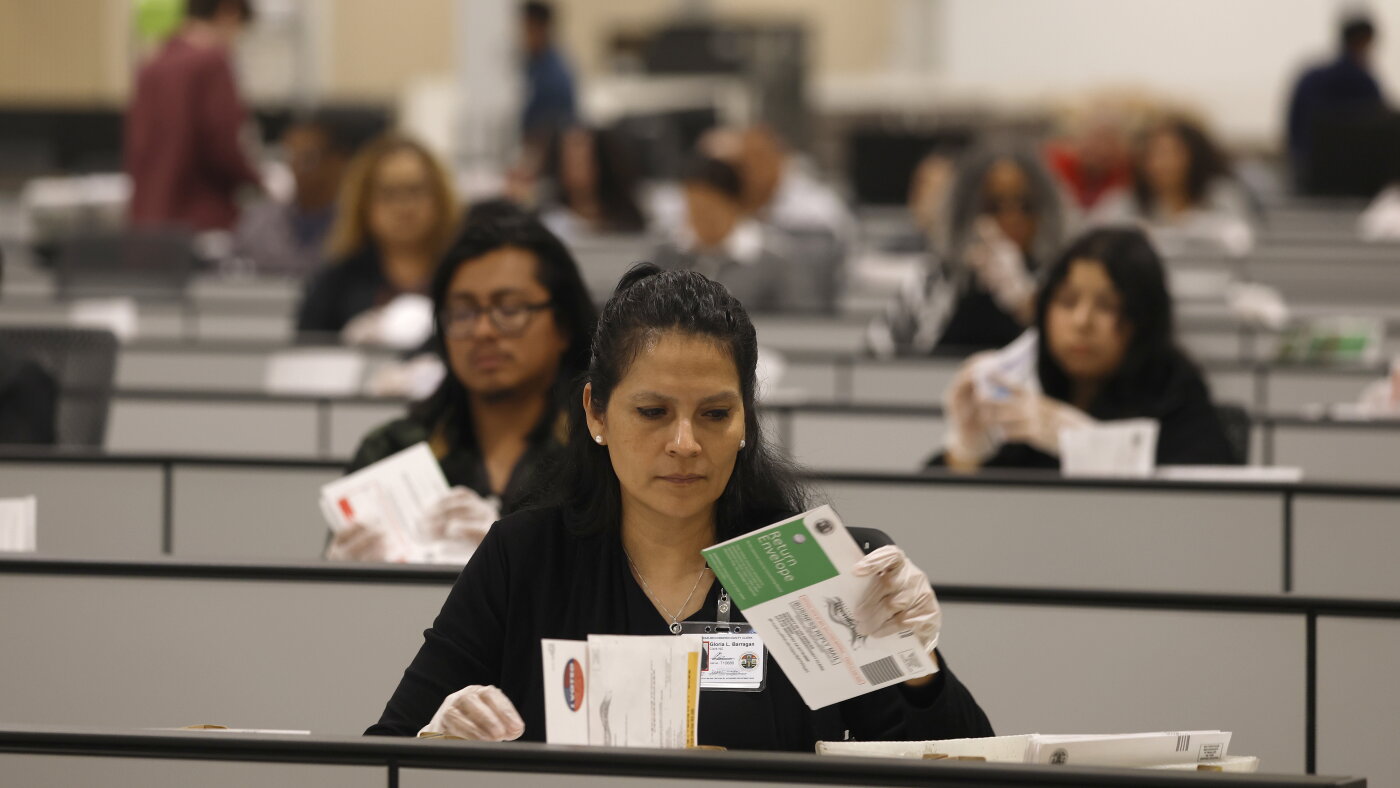
Election workers process ballots for the California state primary at the Los Angeles County Ballot Processing Center on June 5. California's relatively slow vote count has put "a big target on its back," one expert told NPR. Justin Sullivan/Getty Images hide caption Stephen Richer no longer runs elections in the fourth-largest county in the country.
(暂无翻译) (暂无翻译) (暂无翻译)
But for the rest of his life, he'll remember the feeling when polls closed on an election night.
(暂无翻译)
More than a million ballots staring at him and his staff.
(暂无翻译)
Every moment that passes without them fully counted means another conspiracy theory sprouting online. "Those days, those were hell for me," said Richer, a Republican who served as the clerk and recorder for Arizona's Maricopa County.
(暂无翻译) (暂无翻译)
"You'd have a limited number of workers, and you'd have a limited amount of space, and you'd be doing everything that you possibly could. … And yet you have everyone blowing up your phone, everyone saying that you're incompetent or corrupt or worse." This midterm year, election officials in competitive congressional districts will face that same pressure.
(暂无翻译) (暂无翻译)
But they will also face a hard reality: that those races might not be called until days after Election Day.
(暂无翻译)
Here's an FAQ on why that is, and what it could mean this year.
(暂无翻译)
Which sounds strange, since who wins an election and by how much shouldn't impact how long it takes election officials to count ballots.
(暂无翻译)
But the reality is what most Americans think of as "election results" — the winners announced on election nights across TV networks and social media — are not the result of all ballots being counted, but rather, races being called by news organizations that determine the winners based on a state or district's demographics and initial returns. (NPR relies on The Associated Press for its race calls.) Those determinations come a lot faster when races aren't close.
(暂无翻译)
"Margins matter," said Richer, who noted that in recent elections, there has been a lot less scrutiny on Utah than there has been on his home state of Arizona, or certain contests in California, despite the states counting votes at similar speeds.
(暂无翻译)
"In Utah you can call all the races very quickly because the Republicans there have high margins," Richer said.
(暂无翻译)
That gives the illusion of elections there being complete, but no state is done counting ballots on election night, even if it seems that way because notable races are called early.
(暂无翻译)
The closer the race, the more election analysts need to see before they can make a call.
(暂无翻译)
So the faster states count ballots, the faster those determinations can be made.
(暂无翻译)
This is why the longest wait times every election usually come from places that have competitive races and which also count slowly. Exactly. California has become the poster child for long results times because of both those factors: a bevy of competitive congressional districts, which help determine the balance of power in the U.S.
(暂无翻译) (暂无翻译)
House, and a vote count that's been among the slowest in the nation.
(暂无翻译)
Add in that President Trump, the most prominent purveyor of election misinformation in the country, has long targeted the liberal California, and experts see a perfect storm for false voting narratives. "It's progressive, it likes mail ballots, it gets [postmarked] mail ballots after Election Day," Richer said. "It just all adds up to a fairly incendiary situation."
(暂无翻译) (暂无翻译) (暂无翻译)
Charles Stewart, an elections expert at MIT, put it more simply.
(暂无翻译)
"California just has a big target on its back," said Stewart. Kim Alexander is cautiously optimistic that won't be the case.
(暂无翻译) (暂无翻译)
She runs the California Voter Foundation, which has been advocating for ways to speed up California's vote tally without giving up the state's generous voting access policies, like mailing every active registered voter a ballot.
(暂无翻译)
"We have all these amazing rights and opportunities that we give to our voters, and the price we're paying is a longer vote count," Alexander told NPR.
(暂无翻译)
"But that doesn't mean that it has to be this long."
(暂无翻译)
An election worker processes ballots for the California state primary at the Los Angeles County Ballot Processing Center on June 5.
(暂无翻译)
Justin Sullivan/Getty Images hide caption The single biggest cause for California's slow count comes from a phenomenon Alexander calls "the pig in the python" problem: a logjam of millions of vote-by-mail ballots getting returned on Election Day that need to be processed. Those ballots take longer to count than in-person votes, as officials need to deal with envelopes and verify signatures to make sure mail ballots are cast by the people they're supposed to be cast by.
(暂无翻译) (暂无翻译)
Some counties see up to 50% of their vote-by-mail ballots turned in on Election Day, Alexander said, which means processing work doesn't even begin until later in the week. "I can't tell you how many people who are informed and engaged and … when I tell them that the cause for the long vote count is voters holding on to their ballots to Election Day and turning them in, they look at me and they're like, 'That's what I do,'" Alexander said.
(暂无翻译) (暂无翻译)
"And I'm like, 'I know!
(暂无翻译)
You're part of the problem!'" The state allocated $40 million to speeding up its counting this year, and part of that money is going to voter education.
(暂无翻译)
Alexander is optimistic that once voters learn they can play a role in speeding up the process by voting earlier, or by utilizing other voting methods that allow for quicker counting, they will respond.
(暂无翻译)
"California has been beaten up by this president for over a decade over our election process, and it's gotten pretty worrisome," Alexander said. "I think that California voters, if they feel they can do something to respond to that, many will take action." To that point, research conducted earlier this year found that when voters in California's San Joaquin County received postcards urging them to vote earlier, they were more likely to meet the recommended deadline that allowed for election-night counting.
(暂无翻译) (暂无翻译) (暂无翻译)
Alexander noted one more change that could mean less spotlight on California this year: fewer competitive House districts.
(暂无翻译)
Ahead of the 2022 elections, the state had nine districts that the Cook Political Report considered competitive.
(暂无翻译)
But this year, in part because voters approved a mid-cycle gerrymander to respond to gerrymanders in Republican-controlled states, the state has just three. That makes it less likely the entire country will be waiting on California to know who controls the House.
(暂无翻译) (暂无翻译)
Using the formula discussed earlier (competitive races + slow vote counting), it's impossible not to look at Alaska.
(暂无翻译)
According to data from the MIT Election Lab, Alaska was the last state in 2024 to reach 95% of its ballots counted.
(暂无翻译)
Election Day was Nov. 5 that year, but the state's lone House race — which Republican Nicholas Begich won by fewer than 10,000 votes — wasn't called by the AP until Nov. 20. This year, polling shows a tight Alaska Senate race.
(暂无翻译) (暂无翻译)
That means, if results fall a certain way in other states, the entire country could be waiting weeks to know which party will control the U.S.
(暂无翻译)
Senate next year.
(暂无翻译)
仅供学习使用,如有侵权请联系删除 · 查看原文