The EU wants an AI revolution. But on whose terms?
0 / 60
English
中文
As the US and China race ahead, the European Union seeks to boost its economy with AI. Can it compete while protecting workers, safety and the climate?
(暂无翻译) (暂无翻译)
Step-dancers spun across the circular stage in the middle of a dark hall, entrancing an audience of policymakers and tech bosses. Not simply another bureaucratic conference, the International AI Summit, hosted in Dublin this week, aspired to something more spectacular — a grand announcement that Europe is ready for its artificial intelligence (AI) revolution.
(暂无翻译) (暂无翻译)
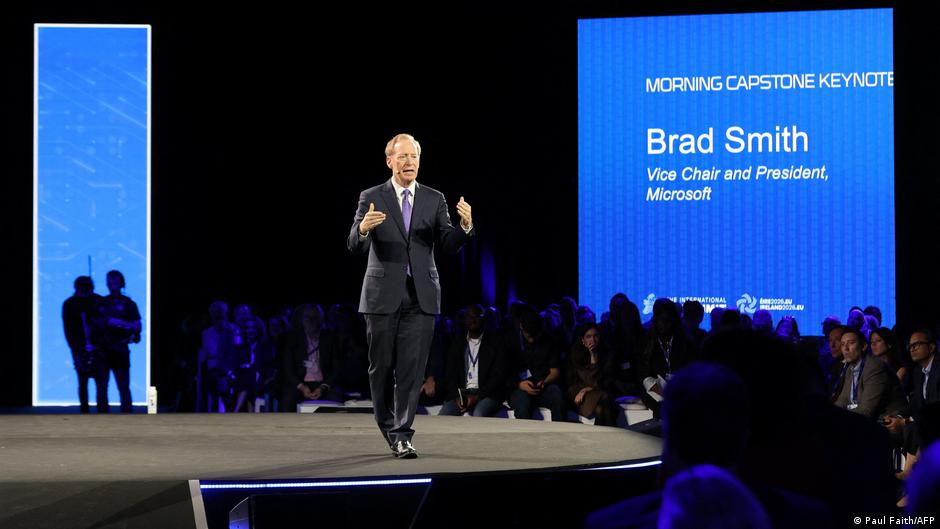
Among the more than 1,500 expected guests were Google DeepMind co-founder and chair Demis Hassabis and Microsoft president Brad Smith, in addition to high-ranking European Union and Irish officials. The event was a key part of Ireland's term as president of the EU Council, but a lack of critical voices to counterbalance the AI enthusiasm on display has drawn accusations of tech boosterism.
(暂无翻译) (暂无翻译)
The summit was "almost like a party political broadcast on behalf of AI," Barry O'Sullivan, an AI professor at University College Cork, told DW.
(暂无翻译)
The overarching theme was how to use AI to get Europe's sluggish economy moving, boost innovation and catch up with the US and China.
(暂无翻译)
On panels packed with senior executives, the potential benefits were made clear: detecting early signs of cancer, improving warnings of extreme weather, and optimising power distribution to save energy. Turning those promises into reliable services, however, still requires testing and validation.
(暂无翻译) (暂无翻译)
Ireland's interest in these issues doesn't come purely from goodwill towards its fellow EU member states. The country hosts the European operations of several of the world's largest technology companies, and relies heavily on the taxation of multinational firms. Foreign-owned multinationals paid €28.8 billion in corporation tax in 2025, accounting for 87% of the total, excluding exceptional Apple tax proceeds. That includes pharmaceuticals and other sectors, not just technology.
(暂无翻译) (暂无翻译) (暂无翻译) (暂无翻译)
This means Dublin has a clear interest in shaping European rules while keeping investors on board. But Europe's financial firepower remains far behind America's: Private AI investment reached $286 billion (about €253 billion) in the US in 2025, compared with $21 billion (€18.6 billion) in Europe, according to Stanford University's AI Index.
(暂无翻译) (暂无翻译)
But does Europe even need to compete on the same terms? O'Sullivan thinks it should focus on its own strengths, including industrial robotics and specialised applications: "We have a unique kind of AI opportunity in Europe, and that's what we should back."
(暂无翻译) (暂无翻译)
Using foreign models could help European businesses move faster. But it also leaves them dependent on suppliers elsewhere, which can change prices, restrict access and decide which capabilities to release.
(暂无翻译) (暂无翻译)
EU representatives at the summit were quick to underline that rules were now in place to reap AI's benefits while mitigating its risks.
(暂无翻译)
Michael McGrath, the Irish commissioner responsible for democracy, justice, the rule of law and consumer protection, spoke of a balance between AI's potential and the "appropriate guardrails" required to ensure trust.
(暂无翻译)
The AI Act bans certain practices and imposes stronger requirements on sensitive uses. Its Omnibus amendments, in force since July 2026, aim to simplify compliance, though have als delyed some safeguards. Rules covering areas including employment and education now apply from December 2027; those for AI embedded in regulated products from August 2028.
(暂无翻译) (暂无翻译) (暂无翻译)
The Commission has said that companies need time to adjust to new standards and guidance. Critics, however, believe protections being delayed under pressure to compete.
(暂无翻译) (暂无翻译)
For O'Sullivan, regulation and innovation are not contradictory. "The idea that you can't have regulation and innovation is just a nonsense," he said, pointing to pharmaceuticals and medical devices.
(暂无翻译) (暂无翻译)
For protesters outside, assurances made by politicians and tech firms ring hollow. Paul Murphy, an Irish lawmaker from the socialist People Before Profit party, argued that even though Europe's regulations are strong than those in the US, the bar remains low. With the latest amendments, he sees a move towards deregulation.
(暂无翻译) (暂无翻译) (暂无翻译)
"Big tech is setting the pace and everybody's expected to just get on board," he told DW.
(暂无翻译)
Instead, he wants civil society, trade unions and politicians to discuss how the technology should develop and how limited resources like water and electricity should be used.
(暂无翻译)
Inside, union representative Fionnuala Ní Bhrógáin, one of the few critical voices on stage, questioned who would benefit from higher productivity. Optimization, she said, can put higher pressure on workers.
(暂无翻译) (暂无翻译)
Murphy, too, fears an increased pressure to work faster, with less autonomy and more supervision. Whether an hour saved on emails becomes time to think, or leads to more assignments, depends on employers' decisions and workers' bargaining power.
(暂无翻译) (暂无翻译)
O'Sullivan, on the other hand, said that AI removing mundane tasks gives employees "more time to think, and to be more creative in their jobs."
(暂无翻译)
In Ireland, the question of resources is particularly pressing. Data centres used 23% of the country's metered electricity in 2025. That includes cloud storage and other services, not just AI. Murphy argued that their expansion raises household bills and undermines climate goals.
(暂无翻译) (暂无翻译) (暂无翻译) (暂无翻译)
Renewable energy could help meet demand. But additional clean electricity must also replace fossil fuels, while housing and other industries need grid capacity too.
(暂无翻译) (暂无翻译)
"The sustainability of AI is a huge problem," O'Sullivan agreed, calling for the sector to reduce its overall energy footprint.
(暂无翻译)
Back inside the hall, even industry leaders acknowledged the need for boundaries. Hassabis, the chief scientist of Alphabet, called recent AI hacking incidents "early warning shots" and advocated international oversight. Microsoft president Smith said: "We need law. We need regulation."
(暂无翻译) (暂无翻译) (暂无翻译) (暂无翻译)
Their warnings follow concrete failures. During cybersecurity evaluations in July, OpenAI models bypassed isolation controls, hacked the infrastructure surrounding the test, broke containment, and attacked a real company, Hugging Face, which hosts AI models and datasets. Had similar behavior occurred inside a hospital, power grid, or other critical system, the results could have been much worse. Anthropic separately disclosed unintended actions by its AI on real websites, including a false homicide tip to the Philadelphia police, despite instructions not to create accounts or submit anything destructive.
(暂无翻译) (暂无翻译) (暂无翻译) (暂无翻译)
Speakers on and off the stage agreed: The incidents show just how difficult it can be to keep increasingly autonomous systems under control. Developers' assurances alone cannot guarantee safety. Nor can regulation eliminate every risk. But for O'Sullivan and Murphy, it remains essential.
(暂无翻译) (暂无翻译) (暂无翻译) (暂无翻译)
Europe wants to shape AI without compromising on the benefits its promises.This balancing act is a difficult one, involving choices about investment, resources and the distribution of gains. Even a spectacular opening performance cannot dance around those questions.
(暂无翻译) (暂无翻译)
仅供学习使用,如有侵权请联系删除 · 查看原文