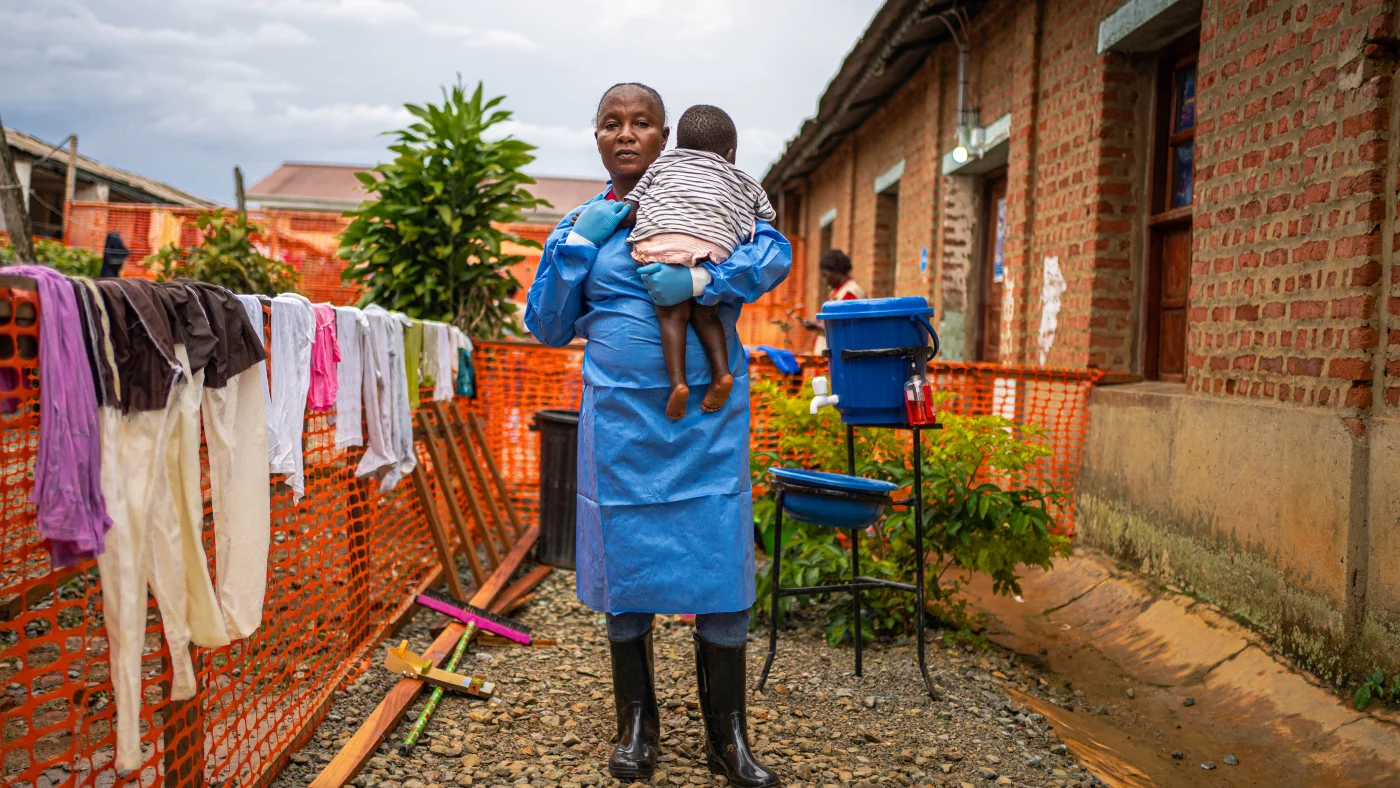
The Ebola outbreak is breaking records -- and just marked a grim milestone
0 / 72
English
中文
Marie Bakikula, a caregiver at a UNICEF-supported nursery in Mongbwalu in the Democratic Republic of Congo, works at an emergency nursery for Ebola orphans. Marie Ruwet/AFP/via Getty Images hide caption The fastest spreading Ebola outbreak in history has surpassed another grim milestone.
(暂无翻译) (暂无翻译)
More than 10,000 people have been infected since the outbreak was first declared in May, according to the latest government figures from the Democratic Republic of Congo. "It's a milestone that we're all surprised to be passing this quickly," says Katie Thomas-Canfield, interim Ebola response director for the International Rescue Committee.
(暂无翻译) (暂无翻译)
"10,000 people affected by Ebola in such a short period is really staggering," she says, noting that at this point in the West Africa outbreak of 2014-2016, only about 4,000 people had been infected. But that earlier outbreak still has the highest case count — more than 28,000 cases. The current outbreak is also the largest ever in geographic scope, spanning Nigeria to Kenya.
(暂无翻译) (暂无翻译) (暂无翻译)
It is second in the death toll, with nearly 5,000 deaths compared to the previous toll of over 11,000. About a third of those who've died in this outbreak have been kids.
(暂无翻译) (暂无翻译)
Children under 5, with their developing immune systems, are hit especially hard — roughly three out of four infected have died. "Behind every figure is a life interrupted, a family mourning, a health worker under pressure and a community seeking reassurance," said Mohamed Janabi, regional director for the World Health Organization Africa, at a press conference last week.
(暂无翻译) (暂无翻译)
"We must reach people earlier, bring safe care closer, and strengthen trust before fear becomes a barrier to survival." A woman mourns the loss of a relative suspected of having died from Ebola.
(暂无翻译) (暂无翻译)
Jospin Mwisha/AFP/via Getty Images hide caption Here's a look at some of the key questions about the 2026 outbreak. Part of the answer lies in uncertainty over when the virus started circulating While the outbreak was officially declared in May, more recent evidence suggests the virus likely started spreading in February or March.
(暂无翻译) (暂无翻译)
"That's a really long time for things to be undetected in communities, and that means we started at a disadvantage," says Thomas-Canfield.
(暂无翻译)
A confluence of factors contributed to the delay.
(暂无翻译)
First, there's the fact that a rarer species of Ebola is behind the outbreak — Bundibugyo.
(暂无翻译)
Existing tests weren't calibrated for this species, leading to delays. What's more, this region of northeastern DRC is remote and beset by conflict.
(暂无翻译) (暂无翻译)
And U.S. cuts to foreign aid may have slowed disease surveillance efforts, says Nahid Bhadelia, an infectious disease physician at Boston University. Workers build an Ebola treatment center in Beni territory of North Kivu Province, the Democratic Republic of the Congo. Xinhua News Agency/via Getty Images hide caption In those early days, "the writing was on the wall that this would be a hard road and it would need international cooperation," says Bhadelia. International cooperation and support have been slower in coming than in previous Ebola outbreaks.
(暂无翻译) (暂无翻译) (暂无翻译) (暂无翻译)
In 2014, for example, healthcare workers from around the globe traveled to West Africa to bolster the response. Bhadelia was one of them.
(暂无翻译) (暂无翻译)
"I think you are seeing a lot less American or other healthcare workers coming into DRC because of U.S. policy that Americans may not be allowed back even if they're sick," says Bhadelia. That's different from the policy in the prior major outbreak.
(暂无翻译) (暂无翻译)
"That means that a lot of the burden is being carried by DRC and regional healthcare workers." Despite pledges of funding from around the world, including more than $880 million from the U.S., some health workers on the ground say that money is slow to materialize.
(暂无翻译) (暂无翻译)
"The scale of financing that's available for this response is really a fraction of what it was in our previous response," says Thomas-Canfield. "I think the degree of international solidarity has been a lot less." A Kenyan Ministry of Health official checks the temperature of a traveler on the Kenya-Uganda border as health authorities step up Ebola screening measures, On October 12, Kenya reported its first-ever Ebola death — a Kenyan man who had been living in the Democratic Republic of Congo died after returning to the country.
(暂无翻译) (暂无翻译) (暂无翻译)
Bright Emoja/AFP/via Getty Images hide caption The response on the ground has improved over the past several months. There are now two dozen or so diagnostic labs and more than 50 treatment centers. "We're up toward almost 2,000 treatment beds for Ebola, so there's been a lot of progress," says Douglas Noble, global incident manager for Ebola at UNICEF.
(暂无翻译) (暂无翻译) (暂无翻译)
Nonetheless, roughly two-thirds of deaths are occurring in the community, not in treatment centers — a sign that people are not coming forward with symptoms. That figure has been stubbornly constant for months and needs to improve for the outbreak to get under control, says Noble.
(暂无翻译) (暂无翻译)
Part of why people aren't seeking care may be that Bundibugyo infections can seem mild at first. "Things like fever, headache, body ache, they're all symptoms of the most common and largely treatable endemic diseases in the region," says Thomas-Canfield.
(暂无翻译) (暂无翻译)
Those who are infected with Ebola may not decide to seek treatment until it's too late, he says. A bigger hurdle, say many healthcare workers on the ground, is community distrust. An October survey from the International Rescue Committee found that 85% of respondents in North Kivu — a current hotspot — say that distrust of community responders is keeping them from seeking care.
(暂无翻译) (暂无翻译) (暂无翻译)
"We're constantly fighting different kinds of rumors, different kinds of misinformation," says Thomas-Canfield of the International Rescue Committee. Many community members question whether Ebola is real or believe responders are just trying to make money. Others wonder why teams come for Ebola and not other diseases that afflict the region, like malaria or typhoid.
(暂无翻译) (暂无翻译) (暂无翻译)
Community health workers are working hard to rebuild that trust.
(暂无翻译)
"I do think that in areas where we've been able to establish a longer-term presence, we're better able to respond," says Thomas-Canfield.
(暂无翻译)
But the virus is rapidly spreading to new health zones. Building trust from scratch is hard, she says. That's especially true in conflict zones, where fighting makes it hard to work, and armed groups actively sow disinformation.
(暂无翻译) (暂无翻译) (暂无翻译)
When trust is low, people don't seek care or engage with health officials trying to find new cases and isolate their contacts. Roughly 80% of new cases are still coming in from people who weren't on health officials' radar. Until that rate goes down, the outbreak will remain out of control, says infectious disease doctor Bhadelia. She points to the cases in Nigeria and Kenya this month as proof of that point. "The sporadic cases that we're seeing in neighboring countries is a sign of the growth in DRC," she says.
(暂无翻译) (暂无翻译) (暂无翻译) (暂无翻译) (暂无翻译)
While daily case counts seem to be plateauing, she says there's likely many regions where the virus is spreading undetected. "It's so far out of control." No vaccine or treatment is licensed for the Bundibugyo species of Ebola.
(暂无翻译) (暂无翻译) (暂无翻译)
Several are in the works, but all far from being used in this response. There is an existing vaccine for Ebola. It's called Ervebo, but it targets a different species of the disease. It hasn't been widely deployed, but healthcare workers began receiving the vaccine in late August and researchers just started a clinical trial, dubbed Tumaini after the Swahili word for hope, aimed at testing how well Ervebo works against Bundibugyo.
(暂无翻译) (暂无翻译) (暂无翻译) (暂无翻译)
If it proves effective, "that would be amazing, that could make a difference," says Bhadelia. But she cautions that vaccines and new treatments are not a silver bullet.
(暂无翻译) (暂无翻译)
A person who died of Ebola is buried at a cemetery in Mongbwalu, Ituri province, eastern Democratic Republic of Congo. Michel Lunanga/Getty Images hide caption "Targeted medical countermeasures are necessary, but they are not sufficient," she says. These interventions need to be coupled with basic public health measures, like tracing all the contacts for a newly infected person and isolating and treating those who are stricken. Improving these strategies takes more work and resources, she says, and she worries that the needed support may not come fast enough. "In this moment, the question that scares me more than anything is will the international community turn its eyes and forget about DRC?" she says.
(暂无翻译) (暂无翻译) (暂无翻译) (暂无翻译) (暂无翻译)
"I am worried the funding will dry out, that we will not keep paying attention to a public health disaster that is much deeper and bigger in this moment than people realize." For stories about life in our changing world, subscribe to NPR's Global Health newsletter.
(暂无翻译) (暂无翻译)
仅供学习使用,如有侵权请联系删除 · 查看原文