Starlink: How Elon Musk's company influences geopolitics
0 / 64
English
中文
Designed to bring internet access to remote regions, Elon Musk's Starlink has become vital in crisis regions and war zones. But Ukraine also shows the risks of depending on the service.
(暂无翻译) (暂无翻译)
Lack of internet access is a major problem in many regions of the world today.
(暂无翻译)
Starlink was initially developed by the American tech billionaire Elon Musk to solve this problem. It was designed as a way of quickly getting the internet into regions all over the world where this was either impossible to do by conventional methods, or so expensive that it wasn't worth attempting.
(暂无翻译) (暂无翻译)
Since then, Starlink's field of application has widened significantly. It's used as a means of communication in disaster zones, but also by armies or protest movements, for example in regions where the existing internet has been destroyed by enemy fire or shut down by authoritarian governments.
(暂无翻译) (暂无翻译)
But there is a downside: Ukraine's military, for example, is heavily dependent on Musk's satellite system. This has become especially apparent as the service faces external disruption.
(暂无翻译) (暂无翻译)
Starlink, which is operated by Musk's SpaceX company, is a satellite-based system consisting of 10,000 small satellites located around the world. They transfer data packages via laser links and do not require a constant, direct visual link to a ground station.
(暂无翻译) (暂无翻译)
Unlike other internet satellites, which orbit at around 36,000 kilometers (22,000 miles) above the Earth, Starlink satellites are only about 550 kilometers up. This means they can transmit internet signals much faster than the others.
(暂无翻译) (暂无翻译)
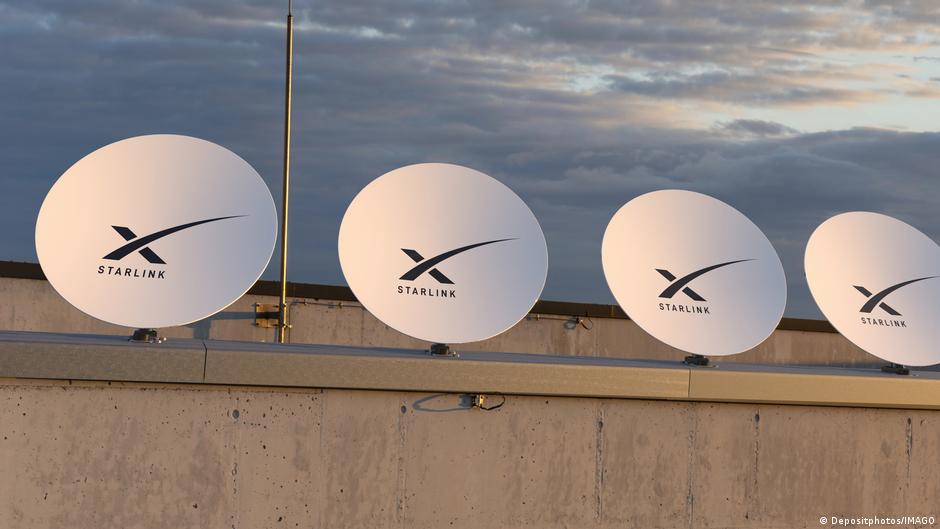
All users need is a small receiver terminal with an electronically controlled antenna, which automatically steers toward the satellites as they pass overhead. The terminals receive signals from these satellites and transmit them to a nearby router, which supplies the broadband internet connection.
(暂无翻译) (暂无翻译)
Ukraine: Since the start of the Russia's full-scale war in February 2022, Starlink has become a vital instrument of communication in the war zone. The Ukrainian armed forces use Starlink to coordinate units, operate drones and control unmanned ground systems. In the civilian sector, the system is used by hospitals, emergency services, energy suppliers and the railway network.
(暂无翻译) (暂无翻译) (暂无翻译)
Ukraine offers a particularly vivid example of how heavily its military capabilities now depend on Starlink.
(暂无翻译)
In mid-October, Ukrainian army units reported disruptions to data transmission, which are said to have severely affected the control of combat, interceptor- and reconnaissance drones. Elon Musk said that restrictions on the speed and use of Starlink are determined by the US military and ultimately the US president. At this stage, it remains unclear who ordered the restrictions.
(暂无翻译) (暂无翻译) (暂无翻译)
Iran: In early January 2026, protests erupted all across the country against the regime in Tehran. The government's hardline response included a nationwide internet shutdown. Reportedly, thousands of Starlink terminals were smuggled into Iran and sold on the black market. This enabled the protest movement to go on coordinating demonstrations against the regime, using Starlink to circumvent state censorship of the internet.
(暂无翻译) (暂无翻译) (暂无翻译) (暂无翻译)
To view this video please enable JavaScript, and consider upgrading to a web browser that supports HTML5 video The country's authorities are cracking down on the satellite service and its users.
(暂无翻译)
Mohammad Amin Aghamiri, the secretary of the Supreme Council of Cyberspace, described Starlink as a hostile "tool of war" and said the regime had means at its disposal to disrupt satellite connections. Starlink is officially banned in Iran.
(暂无翻译) (暂无翻译)
Anyone using the service faces a prison sentence of six months to two years. If users are also charged with endangering national security or espionage, the offence can even carry the death penalty. Sudan: In the Sudanese civil war, Starlink is used primarily by the Rapid Support Forces (RSF), a paramilitary group fighting against the internationally-recognized government.
(暂无翻译) (暂无翻译) (暂无翻译)
Hundreds of devices were smuggled into the country via the United Arab Emirates, and there is now a thriving black market for Starlink terminals in Sudan. The RSF use them to communicate and coordinate with their militias, while the Sudanese Armed Forces are trying to block both the import and use of the terminals. Venezuela: Here too, Starlink has been used in the past to sidestep information blackouts and secure access to the internet.
(暂无翻译) (暂无翻译) (暂无翻译)
For a long time, the service was only available unofficially, by buying kits from local dealers. Following the US intervention in early January 2026, during which then-head of state, Nicolas Maduro, was taken prisoner, Musk offered the people of Venezuela a month's free broadband internet service via Starlink. Gaza: Starlink has been used for humanitarian purposes in the devastated Gaza Strip since July 2024.
(暂无翻译) (暂无翻译) (暂无翻译)
Aid organizations and a field hospital use it to facilitate telemedical assistance and logistical coordination. Access for civilians remains limited because of Israeli security concerns. Starlink is often the only way to access the internet in conflict zones.
(暂无翻译) (暂无翻译) (暂无翻译)
This gives Musk and his operating company SpaceX tremendous influence. Previously, for example, Musk refused to activate Starlink in Ukraine to enable an attack in Crimea. US President Donald Trump has also threatened to switch off the satellites in Ukraine, as a way of forcing Kyiv to make concessions in peace negotiations. There has also been criticism from an ecological perspective.
(暂无翻译) (暂无翻译) (暂无翻译) (暂无翻译)
The Starlink satellites have a lifespan of less than five years. Every day, on average, one or two of them burn up in the Earth's atmosphere. This releases aluminum oxide, which could affect the ozone layer, contributing to global warming. In addition, all those thousands of satellites reflect the sunlight, making the night sky brighter, and this may also have repercussions for the world's animals. In an effort to break Starlink's monopoly, other companies, especially in Europe, are already working on alternatives.
(暂无翻译) (暂无翻译) (暂无翻译) (暂无翻译) (暂无翻译)
At present, the biggest private competitor to SpaceX is a company called Eutelsat. With a fleet of over 600 satellites, its OneWeb service is far smaller, focusing on business customers and maritime use. But Eutelsat is also involved in the development of IRIS2 — an acronym for Infrastructure for Resilience, Interconnectivity and Security by Satellite, an ambitious EU project to establish a highly secure satellite network.
(暂无翻译) (暂无翻译) (暂无翻译)
The aim is to make Europe less dependent on Starlink, but IRIS2 won't be fully operational before 2032. Elon Musk also has competition inside the US from another billionaire, Jeff Bezos, whose company Amazon is currently working on Amazon Leo, known until recently as Project Kuiper.
(暂无翻译) (暂无翻译)
This is establishing a network of more than 3,200 new low-Earth-orbit satellites. Amazon plans to roll out the service later this year in the US, Canada, France, Britain and Germany. The sky is clearly getting crowded.
(暂无翻译) (暂无翻译) (暂无翻译)
China is also refining two satellite communications systems of its own. Guowang, a state project conceived primarily for national and military purposes, will consist of up to 13,000 satellites, while another project, Qianfan, with an estimated 12,000 satellites, is more commercially oriented and aims to provide services to newly industrialized and developing countries. The first mass starts for both of these projects are planned for this year. To view this video please enable JavaScript, and consider upgrading to a web browser that supports HTML5 video This article has been translated from German.
(暂无翻译) (暂无翻译) (暂无翻译) (暂无翻译)
Editor's note: This piece was originally published on February 14, 2026.
(暂无翻译)
It was updated on October 15, 2026, to reflect recent developments.
(暂无翻译)
仅供学习使用,如有侵权请联系删除 · 查看原文