Sidewalk sleepers: They have nowhere else to stay while a loved one is in the hospital
0 / 156
English
中文
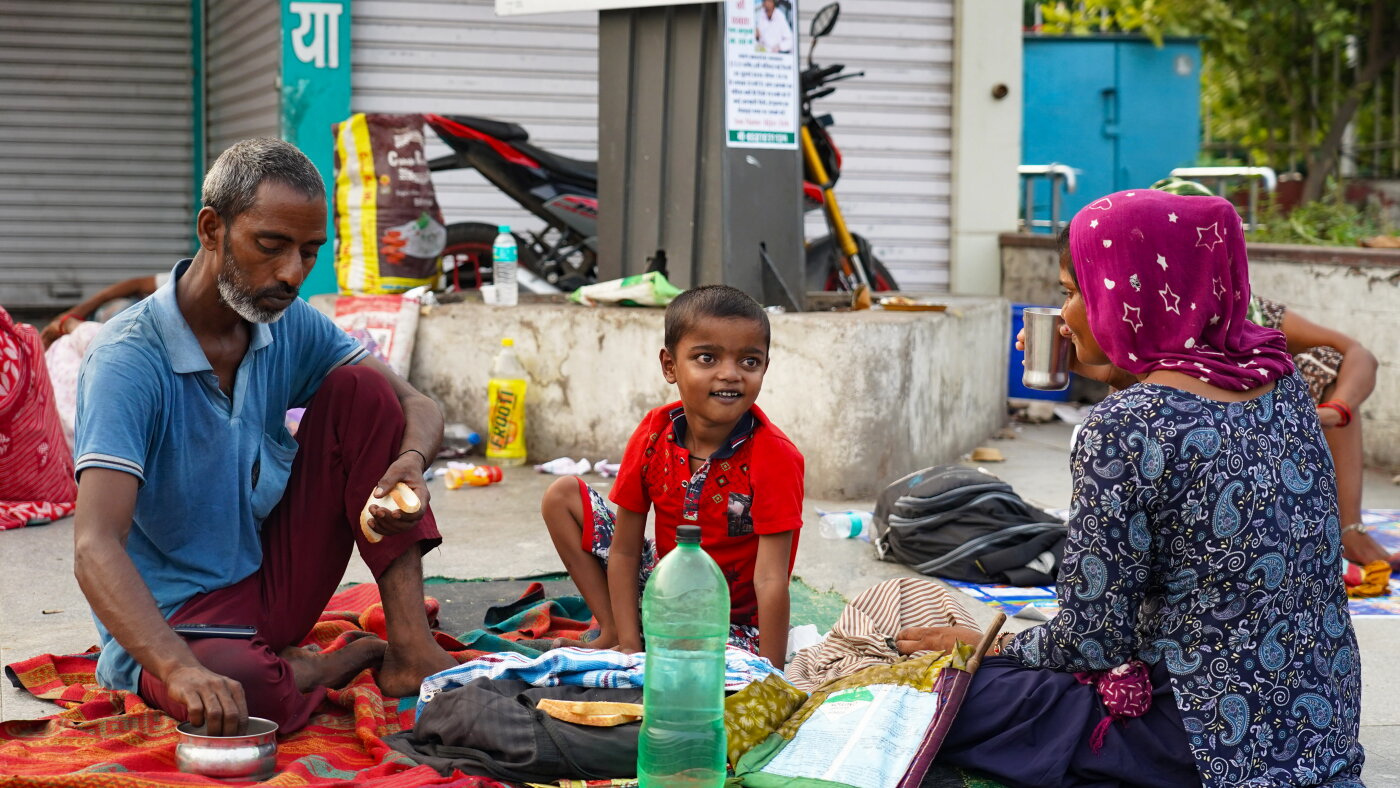
Balraam Singh, 35, eats breakfast with his wife, Nusaa Davii, and their 7-year-old son, Munna, on the pavement outside Safdarjung Hospital in New Delhi, India. The child is receiving treatment for a heart condition, and the family has been sleeping on the pavement outside the hospital for the past 20 days. Sajad Hameed for NPR hide caption DELHI, India — At 2 a.m. on the sidewalk outside one of Delhi's best-known public hospitals, Shabana Kumar gently wakes her husband.
(暂无翻译) (暂无翻译) (暂无翻译)
They sleep in shifts of about an hour at a time because their 6-year-old son is a patient in the oncology ward, being treated for leukemia, a cancer of the blood and bone marrow. They are afraid that if they are both asleep, an urgent call could come about their son's condition and they might miss it. The Kumar family lives more than 600 miles from Delhi in the state of Bihar.
(暂无翻译) (暂无翻译) (暂无翻译)
Arun, 32, works as a farmer. Shabana, 30, is a homemaker caring for their only son. They made the trip to Delhi because they could not afford the cost of their child's cancer treatment in Bihar.
(暂无翻译) (暂无翻译) (暂无翻译)
The All India Institute of Medical Sciences, or AIIMS, subsidizes expenses for families in need. But for many families, there is one challenge they must bear on their own — finding a place to live in Delhi during the days, weeks, even months of treatment.
(暂无翻译) (暂无翻译)
Like the Kumars, families who can't afford to rent lodging often set up a temporary dwelling on the sidewalk. On a night in August, dozens of families were sleeping on blankets or sheets spread directly on the sidewalk.
(暂无翻译) (暂无翻译)
Some tie mosquito nets to railings to protect themselves and their kids. They keep their bags and other belongings beside them as they sleep. Families who have loved ones being treated at the All India Institute of Medical Sciences in New Delhi try to get some rest.
(暂无翻译) (暂无翻译) (暂无翻译)
Thousands of patients and their families travel from across India, sometimes thousands of kilometers, to seek treatment at the hospital. Many who can't afford accommodations sleep on pavement, in subways and in other public spaces near the hospital while waiting for appointments or treatment. Sajad Hameed for NPR hide caption During the day, families move between the sidewalk and the hospital for appointments, tests, medicines and consultations. They carry their most important belongings with them while leaving less valuable items at their sleeping spot.
(暂无翻译) (暂无翻译) (暂无翻译) (暂无翻译)
One family member often stays behind to keep an eye on their things. Like the family from Bihar, people who've accompanied a patient may sleep outside while the patient is housed in the hospital. In other cases, the person receiving care is seen during the day but does not have a bed, so they sleep on the sidewalk as well.
(暂无翻译) (暂无翻译) (暂无翻译)
At night, the sidewalk dwellers return to the pavement, where a small ecosystem has grown around the families. Women cook rice over makeshift brick stoves.
(暂无翻译) (暂无翻译)
Volunteers distribute food. Nearby shops sell medicines and other necessities. Nearby tea stalls not only serve beverages but let families charge their phones. Once strangers, they exchange information about doctors, tests and where to find a free meal or, when none is available, an affordable one they can pay for. Vishnu Singh, 38, serves tea to patients, caregivers and others outside the hospital.
(暂无翻译) (暂无翻译) (暂无翻译) (暂无翻译) (暂无翻译)
Singh runs the stall with his brother, Arjun, and keeps it open 24 hours a day.
(暂无翻译)
Sajad Hameed for NPR hide caption Vishnu Singh, 38, runs a tea stall outside AIIMS. "I see poor people sleeping here every day, so many that I cannot even count them," he said. At AIIMS and Safdarjung Hospital, which is associated with Vardhman Mahavir Medical College, we interviewed families who had traveled from across India, often hundreds of miles from home, to seek medical care.
(暂无翻译) (暂无翻译) (暂无翻译)
The two hospitals stand opposite each other, treating patients with illnesses ranging from cancer and heart conditions to intestinal disorders and other serious ailments.
(暂无翻译)
Some families had been there for a week, others for a month or longer.
(暂无翻译)
For many, returning home between hospital visits was impractical, so patients and the relatives accompanying them stayed in Delhi for the duration of their care. The families we spoke with described their experiences spending days or weeks in Delhi while navigating appointments, tests, consultations and treatment.
(暂无翻译) (暂无翻译)
A family sleeps inside a subway near the All India Institute of Medical Sciences in New Delhi, India. Many families who don't have a place to stay sleep in public spaces near the hospital.
(暂无翻译) (暂无翻译)
Sajad Hameed for NPR hide caption It is a startling contrast — a hospital that provides critical care, that, according to its annual report, gives subsidies to thousands of poor families for treatment — and that is ringed by folks who traveled great distances to find care for a loved one and who cannot afford a place to stay.
(暂无翻译)
NPR reached out to the hospital by email to ask about the issue of accommodations and the community of sidewalk dwellers. The hospital did not respond. AIIMS' website notes that its Medical Social Service Unit provides financial assistance for medical treatment and travel costs for some patients coming from outside Delhi.
(暂无翻译) (暂无翻译) (暂无翻译)
It also states that the unit helps arrange accommodation for out-of-town patients and their family members and caregivers at dharamshalas, traditional charitable lodging facilities affiliated with AIIMS, or other low-cost accommodation.
(暂无翻译)
The website does not say whether AIIMS pays for those accommodations or provides financial assistance specifically for the lodging costs. Shalini Yadav is one of the patients who sleeps on the sidewalk with her parents.
(暂无翻译) (暂无翻译)
Shalini Yadav, 20, who is seeking treatment at the hospital for an intestinal illness that she's suffered from for five to six years, passes the time reading The God of Sins. Sajad Hameed for NPR hide caption Yadav is a second-year college student from Piprat village in Tikamgarh district, Madhya Pradesh, in central India.
(暂无翻译) (暂无翻译)
She had been preparing for the state civil service examination. Her plan was to become a government officer.
(暂无翻译) (暂无翻译)
Now she is spending her days reading Gunahon Ka Devta (The God of Sins), a famous 1949 Hindi tragic romance novel written by Dharamvir Bharati, on the pavement outside AIIMS, waiting to find out when her treatment will begin and when she can go home. Yadav says she has been dealing with an intestinal illness for five or six years and has already undergone two operations.
(暂无翻译) (暂无翻译)
Her family had sought treatment elsewhere before relatives and neighbors advised them to travel to Delhi in search of better treatment at AIIMS — a trip of roughly 370 miles. "We thought AIIMS was the best hospital in India," she said. The cost of staying in Delhi was also a burden: Her family could not afford a room and had already spent thousands of rupees on travel and other expenses.
(暂无翻译) (暂无翻译) (暂无翻译)
When we interviewed her on Aug. 3, she had been there for about three weeks with her parents, Surendra Singh Yadav, 47, a farmer, and Kalpana Yadav, 45.
(暂无翻译)
"We thought the facilities would be good, the doctors would be good, and everything would happen quickly. We never imagined that we would have to sleep on the road," she said. For her, the pavement is not just uncomfortable, it is also frightening. During the day, she says, she can manage.
(暂无翻译) (暂无翻译) (暂无翻译) (暂无翻译)
At night, she worries about the people around her.
(暂无翻译)
"There are all kinds of people here," she says. "Some are good, but some drink or use drugs.
(暂无翻译) (暂无翻译)
There is shouting and fighting. As a girl, I feel very uncomfortable here at night." But the family has little choice.
(暂无翻译) (暂无翻译) (暂无翻译)
They cannot afford a room in Delhi, she says. "We have decided that we have to sleep on the road because there is no other option." During the day, Yadav goes into the hospital for appointments, tests and checkups, then returns to the pavement while waiting for the next step in her treatment. Everything is on hold — her college education, her hopes of qualifying for a government job, her father's farming work.
(暂无翻译) (暂无翻译) (暂无翻译) (暂无翻译)
"It feels like we are being forced to live like this," she says. Lakhi Bai, 62, from Ramnagar in Maihar district, Madhya Pradesh, in central India, about 500 miles away, came to Delhi seeking treatment for diabetes and a condition that she says causes numbness and a loss of sensation in parts of her body. She says she could sometimes sustain an injury without feeling pain.
(暂无翻译) (暂无翻译) (暂无翻译)
When we met her, she had been sleeping outside Safdarjung Hospital for about 20 days. During that time, she says, she had been going to different doctors and departments for consultations and tests but had not yet received a treatment plan.
(暂无翻译) (暂无翻译)
Bai is a farmer and describes herself as a homemaker.
(暂无翻译)
She said she has three sons but is no longer in contact with them.
(暂无翻译)
She came to Delhi alone. Lakhi Bai, a 62-year-old farmer who came to the hospital to receive treatment for diabetes, has been sleeping outside the hospital for about 20 days. Sajad Hameed for NPR hide caption "I cannot afford to bring someone with me," she says.
(暂无翻译) (暂无翻译) (暂无翻译)
"If I bring someone, I have to pay for their food and accommodation, too." It's been a difficult period. "Sometimes I don't even get food," she says.
(暂无翻译) (暂无翻译) (暂无翻译)
"I sleep with an empty stomach." Sleeping outside is also stressful.
(暂无翻译) (暂无翻译)
The heat is hard to endure, she said, as is rainwater. "When it rains, water comes here," she said.
(暂无翻译) (暂无翻译)
"There is nowhere to go." AIIMS did not respond to requests for comment about her account or the experiences described by other families interviewed for this story. Bai did not know how much longer she would have to remain in Delhi.
(暂无翻译) (暂无翻译) (暂无翻译)
"I have no place to stay," she says. "I just pray that I can get the treatment I need and something can be done."
(暂无翻译) (暂无翻译)
In August, Balraam Singh, 35, a brick-kiln worker from Meerut, Uttar Pradesh, had been sleeping outside Safdarjung Hospital for about a month with his wife and their 7-year-old son, Munna Singh. Munna has a heart condition that his father describes as a "hole in the heart."
(暂无翻译) (暂无翻译)
They had come from about 50 miles away seeking further medical evaluation and treatment at Safdarjung Hospital.
(暂无翻译)
"We came with a lot of hope that we would find a doctor and my son would be treated," he says. "But now it feels like we may have to go back without knowing what will happen next. For Singh, who can earn $5 to $7 a day at the kiln where he works, staying in Delhi means not only a loss of income but the need to spend money on food and other daily needs.
(暂无翻译) (暂无翻译) (暂无翻译)
Gulshan Bano, 38, had come to Delhi from Bihar with her 60-year-old mother, Asma Khatoon, and her 6-year-old daughter, Fiza.
(暂无翻译)
They had been sleeping outside Safdarjung Hospital for about a week when we met them in August.
(暂无翻译)
Bano says her mother has had a heart condition for several years and was receiving treatment in Bihar.
(暂无翻译)
Her mother had undergone checkups and tests there, but the family felt she needed further evaluation and care. Gulshan Bano, whose mother has heart disease, sits with her 6-year-old daughter, Fiza.
(暂无翻译) (暂无翻译)
They had been staying outside the hospital for the past 10 days while seeking medical treatment for her mother.
(暂无翻译)
Sajad Hameed for NPR hide caption Relatives also advised them to seek treatment in Delhi, and the family decided to travel for further consultations and tests. Bano said doctors have told them that her mother has a heart problem and have prescribed medication rather than recommending surgery.
(暂无翻译) (暂无翻译)
The family returns to Delhi for checkups about every six months. To pay for the trips, Bano works in domestic jobs in Bihar.
(暂无翻译) (暂无翻译)
"I work for months and save whatever I can, and then I come here," she says. "Whatever little money remains has to be used here." Bano said her husband does not contribute to her mother's medical expenses and she has little choice but to keep making the journey to Delhi.
(暂无翻译) (暂无翻译) (暂无翻译)
A visit can last about a month, Bano said, as the family waits for scheduled consultations, tests and follow-up care.
(暂无翻译)
Because they cannot afford other accommodation, they sleep outside the hospital between appointments and tests rather than return home and make another journey to Delhi.
(暂无翻译)
"Where should I go?" she said. "I have to come here because my mother needs treatment."
(暂无翻译) (暂无翻译)
For families like Bano's, charities and volunteers can provide some of the practical support they need while they wait outside the hospitals. Rajiv Ranjan, who works with the Delhi-based Donate A Meal Trust, said his organization regularly helps patients and their attendants staying outside AIIMS and Safdarjung Hospital by distributing food, clothes and rations.
(暂无翻译) (暂无翻译)
He said the organization has seen many families remain outside the hospitals while seeking treatment or caring for relatives inside.
(暂无翻译)
"We come here for people who sleep outside while they or their family members are receiving treatment inside the hospital," he says. "They have nowhere else to stay, so we try to help with whatever we can."
(暂无翻译) (暂无翻译)
The group distributes about 100 meals a day, Ranjan says. Food, however, is only one of the needs.
(暂无翻译) (暂无翻译)
"People need shade from the sun, and during the rainy season they need somewhere to stay dry," Ranjan said.
(暂无翻译)
"Some of them take shelter under the Delhi Metro, the city's rapid-transit rail system, when it rains."
(暂无翻译)
For Shalini Yadav, the 20-year-old college student from Madhya Pradesh who traveled to Delhi for treatment, the food distributions and other help have become part of life outside the hospital.
(暂无翻译)
She said people arrive to help in whatever way they can, but the assistance does not reach everyone. "Sometimes we get food. When we don't, we buy it nearby.
(暂无翻译) (暂无翻译) (暂无翻译)
But there are many people here who don't get anything to eat."
(暂无翻译)
Suhana Bano, 47, from Bareilly, Uttar Pradesh, has been bringing her 18-year-old son, Mohammad Sameer, to Delhi for treatment for about two years. Suhana Bano, 47, from Bareilly, Uttar Pradesh, has been bringing her 18-year-old son, Mohammad Sameer, to Delhi for medical treatment for about two years.
(暂无翻译) (暂无翻译)
Bano has been staying on the pavement for the past month while waiting for her son's next appointment at the hospital. Sajad Hameed for NPR hide caption Sameer has irritable bowel syndrome.
(暂无翻译) (暂无翻译)
He was in seventh grade when this digestive ailment forced him to leave school. The family first sought treatment at several hospitals in Bareilly, about 155 miles from Delhi, before traveling to Safdarjung Hospital. Suhana Bano said the family turned to Delhi after seeking treatment locally, hoping to find the specialized care Sameer needed.
(暂无翻译) (暂无翻译) (暂无翻译)
The family travels to Delhi whenever Sameer is due for a consultation or tests.
(暂无翻译)
Typically, they stay one to two months, Bano says. While in Delhi, the family sleeps outside Safdarjung because they cannot afford a room. Aamar Singh, 60, a farmer from Hathras, Uttar Pradesh, had been sleeping outside AIIMS for about a week when we met him in April.
(暂无翻译) (暂无翻译) (暂无翻译)
His 35-year-old daughter, Neelam, was admitted to the AIIMS intensive care unit with a respiratory problem, he said. His 40-year-old sister, Rashima, stayed outside with him. At night, they sleep alongside stray dogs that also gather on the pavement.
(暂无翻译) (暂无翻译) (暂无翻译)
Singh does not know how long his daughter will remain in the ICU after being admitted for treatment and therefore does not know how long he will have to remain outside.
(暂无翻译)
Food is not always available, he said, and some days they go hungry. "Sometimes you eat, sometimes you don't," he said. "My daughter is inside, so I have to stay here.
(暂无翻译) (暂无翻译) (暂无翻译)
What else can I do?
(暂无翻译)
This is our situation." So Aamar Singh waits on the pavement for news about his daughter until he can take her home. For stories about life in our changing world, subscribe to NPR's Global Health newsletter.
(暂无翻译) (暂无翻译) (暂无翻译)
Sajad Hameed is an India-based journalist and multimedia storyteller focusing on South Asia.
(暂无翻译)
He writes about politics, human rights, health, business, the economy and the impact of climate change, with particular focus on the region's evolving social and political landscape.
(暂无翻译)
Rehan Qayoom Mir is an independent journalist whose work has appeared in outlets including Al Jazeera English, The Guardian, Nikkei Asia, The Progressive, Jacobin and more. He reports from across India and South Asia, with a focus on ground reporting and human-interest stories.
(暂无翻译) (暂无翻译)
仅供学习使用,如有侵权请联系删除 · 查看原文