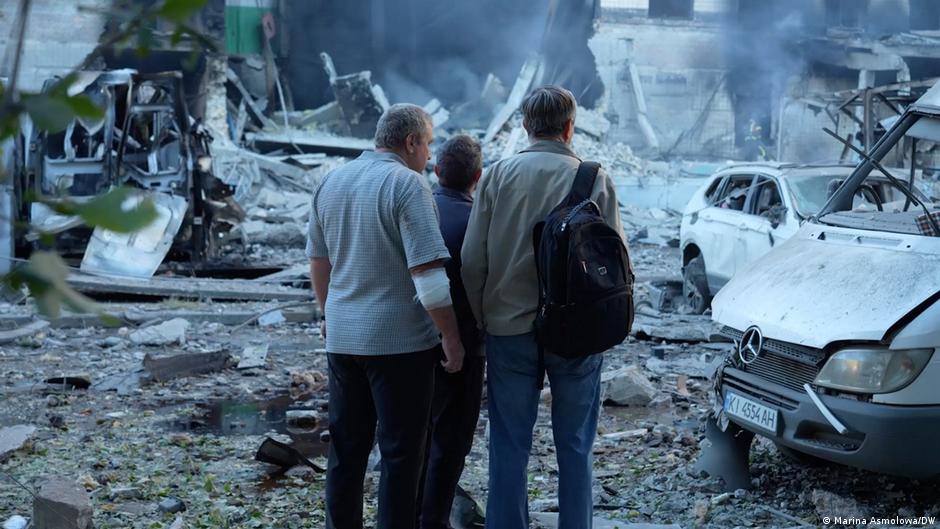
Russia's attacks on Ukraine's capital, Kyiv, are intensifying. DW asked people on the ground what life is like
0 / 47
English
中文
Russia's attacks on the Ukrainian capital are hitting harder and more frequently, making 2026 one of the long war's bloodiest years for Kyiv. DW asked people on the ground what life is like.
(暂无翻译) (暂无翻译)
Until a few months ago, life was relatively peaceful in Kyiv when compared with the situation near the war's front lines elsewhere in Ukraine. Now, as Russia expands its attacks on the capital, Kyiv has increasingly become a front-line city.
(暂无翻译) (暂无翻译)
With too few shelters for the 4 million residents of Kyiv, subway stations double as makeshift dormitories. Starting at about 10 every night, people create sleeping areas with mattresses and small tents. Children snuggle up to adults; pets seek comfort from their owners or find a spot among strangers between the cold walls.
(暂无翻译) (暂无翻译) (暂无翻译)
"We're alive," Halyna told DW, holding her 5-year-old son, Roman, close. "We've been lucky once again." Most evenings — even when no air-raid siren has sounded — she takes the boy to the nearest subway station. Her apartment is located in the Lukyanivka district, which Russia has systematically targeted over the war's four years and eight months.
(暂无翻译) (暂无翻译) (暂无翻译) (暂无翻译)
In September, 14-year-old Daniel Umanskyj was doing homework in his room when a Russian drone struck the apartment building in the central district of Pechersk. A neighbor named Vlad happened to be in the hallway with his daughter at the time of the strike. "We were late that day — and this saved our lives," Vlad said. "Daniel's death is a tragedy." He added: "These sick monsters don't care who they kill." Flowers have been planted in front of the damaged apartment building in memory of Daniel.
(暂无翻译) (暂无翻译) (暂无翻译) (暂无翻译) (暂无翻译) (暂无翻译)
Russia also targets places where children gather. In early October, a drone struck a school building in southwestern Kyiv. Fortunately, pupils and teachers were already in shelters at the time.
(暂无翻译) (暂无翻译) (暂无翻译)
"We've been teaching all the pupils in person because we have a large shelter that can accommodate more than 500 students," Valentyna Chorna, the school's principal, told DW. As there is enough space in the shelter for everyone, students in the first through ninth grades are able to go to school, she said.
(暂无翻译) (暂无翻译)
Whether classes take place depends not only on the decision of the parents and the school administration: It also depends on whether shelters are available and how long the air-raid siren continues to sound. If an alarm sounds in the morning while children are still at home, they may not be able to go to school that day.
(暂无翻译) (暂无翻译)
"This is an enormous burden for parents," said a colleague from the DW bureau in Kyiv, whose daughter attends school. "You have to go to work — and the child stays home alone."
(暂无翻译) (暂无翻译)
"Even the walk to school is dangerous because an air-raid alarm can go off at any time," she said. Her daughter attends a school not far from the Antonov aircraft factory. "One day she texted me: ‘You can't imagine what a huge explosion that was!'" she said. "I don't know if something was shot down or if there was a strike somewhere." She added: "Things like that really scare children." And staying home brings its own risks.
(暂无翻译) (暂无翻译) (暂无翻译) (暂无翻译) (暂无翻译) (暂无翻译)
In September, a Russian drone struck their building. The apartment itself wasn't damaged, and her daughter was at school that morning, but it was another reminder of just how much survival has become a matter of luck. When an air-raid siren sounds, no one knows who will be spared, she said.
(暂无翻译) (暂无翻译) (暂无翻译)
Russia's attacks have become deadlier in 2026. According to the military administration in Kyiv, 140 people were killed in the capital during the first eight months of the year, compared with 172 for all of 2025. If this trend continues, 2026 could become Kyiv's deadliest year since the start of the Russian invasion in 2022.
(暂无翻译) (暂无翻译) (暂无翻译)
Attacks on warehouses have led to shortages in supermarkets on a scale not seen since the early months of the war. At the end of September, emergency power outages resumed in Kyiv. The subway was paralyzed by a Russian attack. Given the strikes on the energy infrastructure, it is unclear how the capital can reliably supply residents with heat, electricity and water during the upcoming winter.
(暂无翻译) (暂无翻译) (暂无翻译) (暂无翻译)
Despite Russia's attempts to render Kyiv uninhabitable, 72% of the city's residents said in September that they are prepared to endure the war for as long as necessary, the Kyiv International Institute of Sociology reported in early October. The authorities are striving to maintain normal life in the city, where the curfew has been shortened and now runs from 1 a.m. to 5 a.m.
(暂无翻译) (暂无翻译)
Some facilities have even been allowed to continue operating during "yellow" alerts. During "red" alerts, however, people must immediately seek shelter: This could mean ballistic missiles, cruise missiles or massive combined attacks.
(暂无翻译) (暂无翻译)
To view this video please enable JavaScript, and consider upgrading to a web browser that supports HTML5 video This article was originally written in Ukrainian.
(暂无翻译)
仅供学习使用,如有侵权请联系删除 · 查看原文