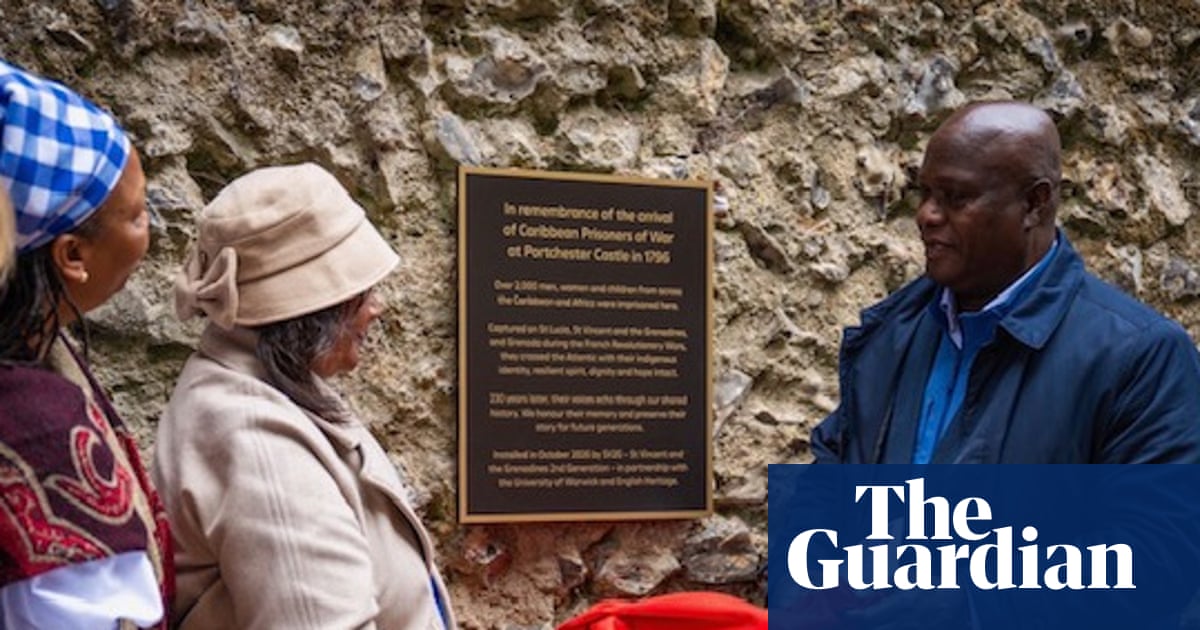
Plaque telling story of African-Caribbean prisoners in Britain stolen within days
0 / 27
English
中文
The theft of a plaque in Hampshire that told the little-known story of African-Caribbean prisoners in 18th-century Britain reflects the enduring racism that has fuelled centuries of atrocities against Black and Indigenous Caribbean people, their descendants say.
(暂无翻译)
Ronald Raymond McDonald, a professional drummer, was part of a delegation that travelled from Belize and elsewhere to Portchester Castle near Portsmouth last week to honour their ancestors: 2,500 men, women and children transported to Britain as prisoners of war in 1796.
(暂无翻译)
McDonald, whose Garifuna ancestors from St Vincent and the Grenadines were among the prisoners, said he was heartbroken to learn that the plaque had been stolen and a nearby bench vandalised with hateful graffiti.
(暂无翻译)
“Why would somebody do something like that when people are simply honouring their ancestors … it’s very sad,” he said.
(暂无翻译)
The plaque, installed at the castle, commemorated the more than 2,000 prisoners held there, marking an extraordinary chapter of Black British history: one of the largest known arrivals of African-Caribbean people in Britain before the Windrush era.
(暂无翻译)
The unveiling was part of a ceremony organised by the St Vincent and the Grenadines 2nd Generation (SV2G), in partnership with the University of Warwick and English Heritage, and was attended by Caribbean communities, diplomats, researchers and heritage organisations.
(暂无翻译)
But days later, English Heritage staff discovered the plaque was missing. They said a padlock to one of the castle gates had been removed and the incident had been reported to police.
(暂无翻译) (暂无翻译)
Garifuna advocate Princess Eulogia Gorden said the theft reflected “a spirit of racism that haunts generation after generation and hides in plain sight”. It was time, she said, to recognise that “we are all connected” and to end the hate.
(暂无翻译) (暂无翻译)
Queen Mother Chief Freda Paulino-Sideroff, who is Garifuna and had travelled to the UK for the ceremony, was returning home to the US when she learned of the theft.
(暂无翻译)
“Hate will never define who we are as a people. We are resilient survivors of our ancestors who have endured,” she said.
(暂无翻译) (暂无翻译)
In the 1700s, her Garifuna ancestors were expelled from St Vincent by British forces and left to perish on the barren island of Baliceaux as Britain sought to crush decades of resistance to colonisation.
(暂无翻译)
Emilio “Sásamu” Thomas, a Garifuna cultural ambassador who also travelled from Belize for the ceremony, echoed Paulino-Sideroff’s sentiments, saying Garifuna people would not allow themselves to be victimised.
(暂无翻译)
His message to the perpetrators, he said, was: “Whatever pain that they are experiencing, we’re here to help them to relieve that pain.” The missing plaque was meant to honour the prisoners, whose story, researchers say, had been largely lost to history.
(暂无翻译)
They came from a coalition that included formerly enslaved Africans, Caribbean-born people, Indigenous people and French soldiers who fought against British control of St Lucia, St Vincent and the Grenadines and Grenada. Their defeat and removal helped strengthen British rule in the region. It was unveiled on 9 October, exactly 230 years after one of the ships carrying the prisoners was wrecked at Rapparee Cove in Devon, with many of those onboard losing their lives.
(暂无翻译) (暂无翻译) (暂无翻译)
Iona Keen of English Heritage called the removal an act of vandalism, while University of Warwick professor Katherine Astbury said the plaque was intended to provide a visible memorial of the prisoners, and a reminder of “an important, forgotten part of Caribbean history”.
(暂无翻译)
The vandalism came during Black History Month and amid renewed debate over slavery reparations.
(暂无翻译)
Campaigner and author Sir Patrick Vernon said vandalism of memorials representing Black British history had occurred repeatedly over decades, citing damage to other memorials. He described the theft as symbolic of an “ongoing battle and the legacy of enslavement”.
(暂无翻译) (暂无翻译)
Jacqueline Roberts, SV2G chief executive, said the theft could not erase history, and stressed the importance of continuing research to uncover more hidden stories.
(暂无翻译)
“Our history is intertwined with British history,” she said.
(暂无翻译)
“It’s important to understand that part of our journey, because it is part of the complexity of our identity, and affects our sense of belonging.” Anthony Severin, St Lucia’s high commissioner and chair of the Caribbean community diplomatic caucus in the UK, described the theft as a “desecration of the memory and spirit of our commemorated ancestors”. He pledged that the plaque “whether returned or replaced, will remain affixed to the walls of Portchester Castle”.
(暂无翻译) (暂无翻译)
仅供学习使用,如有侵权请联系删除 · 查看原文