Loggers say Roadless Rule repeal won't solve their biggest challenges
0 / 58
English
中文
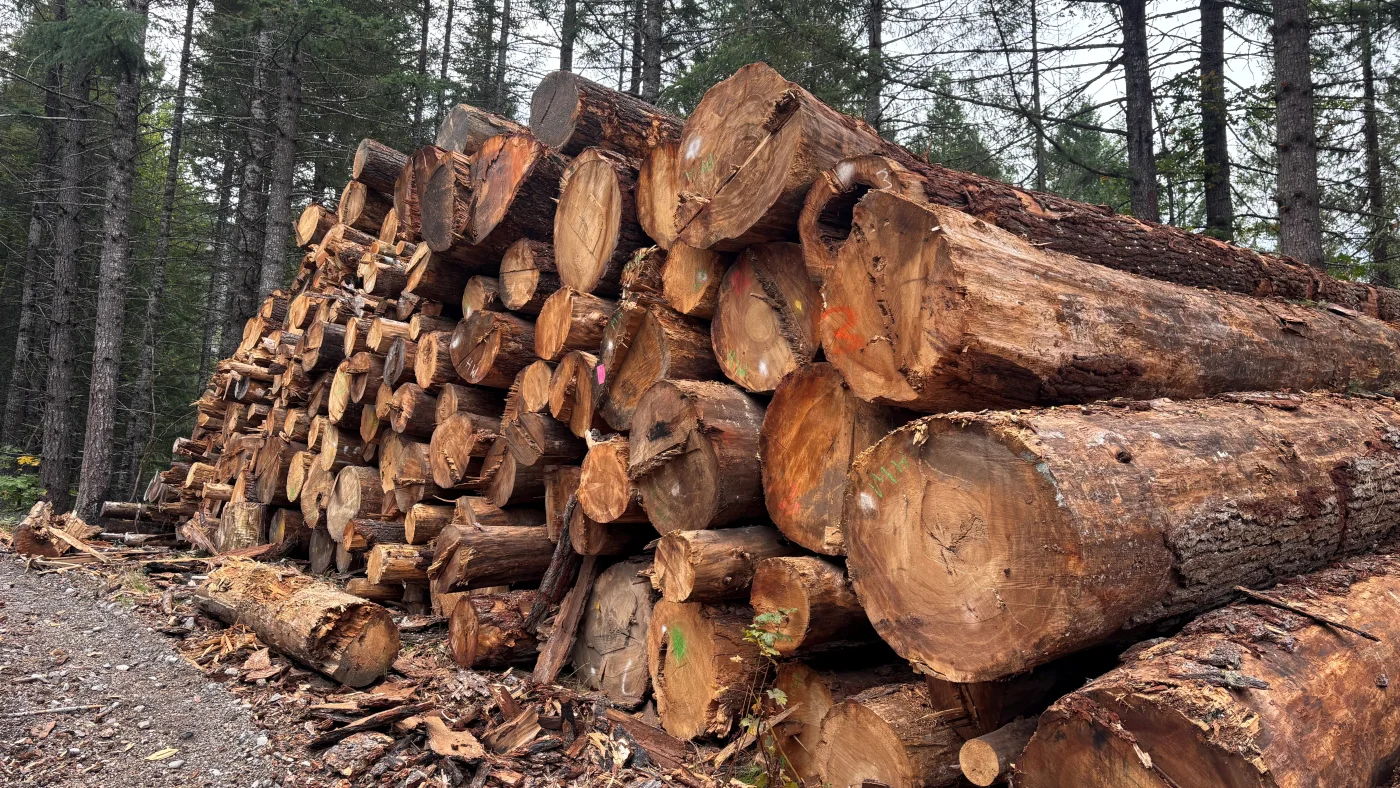
Logs from a salvage timber sale after a recent wildfire in the Willamette National Forest in Oregon. Kirk Siegler hide caption EUGENE, Ore. - President Trump is widely expected to soon open up some 44 million acres of the country's last pristine national forests in a move he says will bring timber jobs back to struggling small towns and help prevent wildfires in overgrown lands.
(暂无翻译) (暂无翻译)
Trump signaled the move with executive actions last year aimed at dramatically boosting timber sales on U.S.
(暂无翻译)
Forest Service land and reversing the agency's 25-year-old Roadless Rule, which blocked most new logging on undeveloped national forestlands. Today with the formal repeal of the Roadless Rule rule expected early next year, the picture on the ground in timber country looks messier.
(暂无翻译) (暂无翻译)
Those who make a living in the forests say the problems are much bigger than access to more trees. "I'm not saying these EOs [Executive Orders] are useless, they set the tone," says Sean Smith, CEO of the family owned Starfire Lumber in Cottage Grove, Ore.
(暂无翻译) (暂无翻译)
Smith, standing in a bustling lumber yard with the sawmill cranking behind four story high stacks of freshly cut timber, says the industry has more pressing challenges now, starting with the record high price of diesel fuel.
(暂无翻译)
Economists largely blame that on Trump's war with Iran. And then there's inflation, which is driving up the costs of just about everything. "Steel, you know, we have to buy sawblades, we have to buy ball bearings," Smith says.
(暂无翻译) (暂无翻译) (暂无翻译)
"We have to buy a million different parts to keep this mouse trap going." So repealing the Roadless Rule - which has largely banned new road building and logging projects on some 44 million acres of pristine national forests since 2001 - is lower on the priority list.
(暂无翻译) (暂无翻译)
Sean Smith, owner of Starfire Lumber in Cottage Grove, Ore. says opening up local roadless forests to forest health projects could create a more reliable local supply for mills.
(暂无翻译)
Kirk Siegler hide caption Smith, a burly man with a dry sense of humor and a neatly trimmed salt and pepper beard, does support the reversal saying it will eventually give industry a more reliable local timber supply. He says a lot of the nearby Willamette National Forest, roaded or not, is dangerously overgrown.
(暂无翻译) (暂无翻译)
That built-up fuel makes these forests more prone to catastrophic wildfires. "This is not a 'gee I sure want more cheap timber volume,' you know, this is not me promoting an agenda," Smith says. "This is a guy who lives here and is tired of seeing these beautiful places burn up."
(暂无翻译) (暂无翻译) (暂无翻译)
Trump says a boom is coming but the industry is a fraction of what it was The administration alongside the timber industry and some local officials are pushing for the repeal, saying it will give the Forest Service more flexibility to carry out wildfire prevention, including tree thinning, on land that's largely functioned as wilderness since 2001. But under recent Republican and Democratic administrations, the Forest Service has struggled to get those projects going on forests that already have roads.
(暂无翻译) (暂无翻译)
Lawsuits and red tape are an ongoing challenge, as is finding enough workers.
(暂无翻译)
"Right now, there's not a ton of people that want to wake up at 2 a.m. and drive a log truck for the same price that you could go work at McDonald's for," says Jeff Brink, a second generation logger near Eugene, Ore.
(暂无翻译)
Brink says the industry is a fraction of what it was when his dad and uncles started Brink Land Development in 1981. The company is getting by ok, for now he says, due to a steady stream of forest restoration projects on private land as well as some recent salvage logging timber sales from nearby wildfire burn scars.
(暂无翻译) (暂无翻译)
But for many smaller, less established loggers already struggling, Brink says, labor shortages and high diesel prices could be the tipping point.
(暂无翻译)
"For an industry already operating on low margins, this is a tough one," Brink says. Due to tightening environmental laws and other market forces including cheaper Canadian lumber imports, timber sales on U.S. federal land dropped by close to 90% since the 1990s.
(暂无翻译) (暂无翻译)
Brink says today the infrastructure just isn't there for the forest work that needs to be done, let alone a promised timber boom.
(暂无翻译)
"Rural Oregon is struggling and all the mills that aren't along the I-5 corridor or near urban centers that can source wood are closing," he says.
(暂无翻译)
Since the 1990s, an estimated 400 mills across the broader Northwest have closed, amounting to the loss of about 35,000 jobs. Seven mills have closed in Oregon since 2024 alone.
(暂无翻译) (暂无翻译)
Industry experts project that overturning the Roadless Rule could lead to a five to ten percent boost in federal timber sales.
(暂无翻译)
That's hardly enough to boost much enthusiasm on the ground. "We're in an industry that for decades has been in a state of contraction," Brink says.
(暂无翻译) (暂无翻译)
Several national environmental groups have also already signaled they plan to sue once the administration formally repeals the rule, which is expected to happen by early next year. Some fear a revival of the bitter Timber Wars Timothy Ingalsbee turns his hybrid station wagon onto Forest Service Road 2408, near the scene of an infamous year-long tree sit and blockade that he helped lead against a Forest Service old growth timber sale in the nineties.
(暂无翻译) (暂无翻译)
"The industry [back then] was headed for a crash, they had exhausted the supply," Ingalsbee says, as he stops the car and gets out at a vista.
(暂无翻译)
Today, his hair cropped shorter and greying, Ingalbee notes that many of those towering, old growth trees, their bark cloaked in moss, have burned in recent wildfires.
(暂无翻译)
Ingalsbee, a retired Forest Service firefighter, today runs a national firefighter safety and advocacy group.
(暂无翻译)
"The claim that they're going to do all this new road building and logging in roadless areas on behalf of wildland firefighters, and make it more efficient for them, is just a big lie," Ingalsbee says.
(暂无翻译)
"Not in our name you don't." Retired U.S.
(暂无翻译)
Forest Forest Service firefighter Timothy Ingalsbee stands by a road in the Willamette National Forest, which was once the epicenter of the so-called Timber Wars. Kirk Siegler hide caption Ingalsbee fears that punching even more roads into these forests will lead to more human-caused wildfires, which have been rising steadily for decades.
(暂无翻译) (暂无翻译)
But he doesn't think any of this is really about wildfire prevention or creating more logging jobs. "What's driving a lot of Trump's executive orders for public lands management is not real economic drivers.
(暂无翻译) (暂无翻译)
I don't hear industry clambering for this," he says. "It's more ideology." For Ingalsbee, the U.S. government is just racing to open up as much of the West as possible so industry can squeeze out maximum profits on timber, oil and coal.
(暂无翻译) (暂无翻译) (暂无翻译)
Everyone is tired of policies 'whipsawing' from one president to the next One thing that almost everyone on the ground in the Northwest agrees on is that Congress has largely failed to act on either protecting or opening up federal forest lands to more development. When President Clinton signed the Roadless Rule by executive order at the end of his second term, Republicans controlled both the Senate and the U.S.
(暂无翻译) (暂无翻译)
House where appetite for passing more wilderness legislation was slim. The rule was the culmination of a sweeping inventory of land conducted by the Forest Service in which the agency had marked certain forests as prime acreage for wilderness protection. Congress never codified it, and since then, the administrative rule has become an environmental flashpoint in a polarized country.
(暂无翻译) (暂无翻译) (暂无翻译)
Back at Starfire Lumber, CEO Sean Smith is tired of federal forest and timber policy whipsawing from one presidential administration to the next.
(暂无翻译)
"Sometimes the cynical side of me says, 'hey, what could be better than a do-nothing Congress at least they're not screwing anything up," Smith says, with a sardonic chuckle.
(暂无翻译)
"But that's no way to run a country long term."
(暂无翻译)
Not to mention, he adds, it makes for a hard environment to keep a business going in.
(暂无翻译)
仅供学习使用,如有侵权请联系删除 · 查看原文