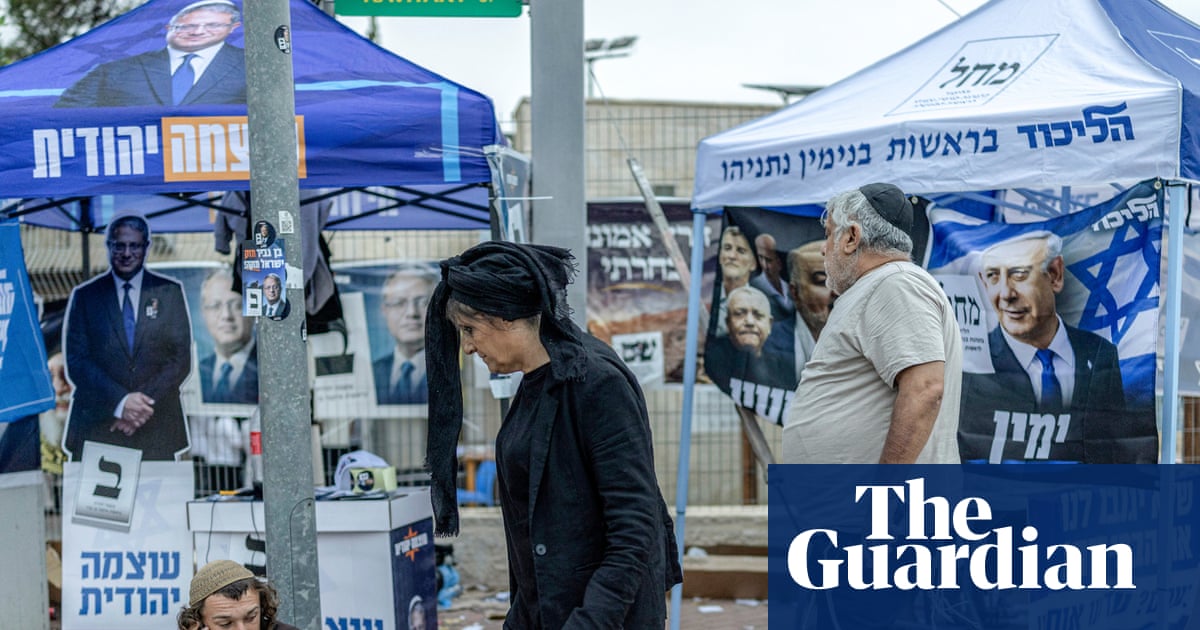
Legacy of 7 October looms large as a divided Israel goes to the polls in record numbers
0 / 49
English
中文
Election day in Israel began with a protest by some of the voters with most at stake. Bereaved families of those killed in the 7 October attacks held a minute of silence at 6.29am, the moment when Hamas launched its onslaught just over three years ago.
(暂无翻译) (暂无翻译)
They gathered in a Tel Aviv plaza that has become known as “hostages square” because it was the centre of demonstrations demanding the return of more than 200 captives from Gaza. Holding pictures of their loved ones, they stood in silence then called on voters to remember the losses and betrayals of that day when deciding on the next government.
(暂无翻译) (暂无翻译)
“Three years after the massacre, our loved ones will not be voting today. Go out and vote – remember them at the ballot box. This is what these elections are about,” the group said.
(暂无翻译) (暂无翻译) (暂无翻译)
They are not explicitly backing any political party, but one of their key demands is a state commission of inquiry into the attacks. Benjamin Netanyahu has resisted this and it has become a rallying point for the opposition parties trying to unseat him as prime minister.
(暂无翻译) (暂无翻译)
Netanyahu’s strongest challenger, Gadi Eisenkot, started the day by visiting communities attacked on 7 October. “If someone in the government had a shred of responsibility, they would start the morning here,” said the former military chief and leader of the Yashar party.
(暂无翻译) (暂无翻译)
Standing in a cheering crowd, Eisenkot called on all Israelis to vote to get rid of “the worst government Israel has known”. He noted that victory wasn’t certain, adding that “we are on perhaps the most critical day since the founding of the state”.
(暂无翻译) (暂无翻译)
As the day wore on, it became clear that voter turnout was shattering all records and among those lining up at polling stations were tens of thousands of Israelis who live overseas.
(暂无翻译)
A bipartisan “Fly&Vote” initiative was set up to support those who wanted to return because electoral law only allows voting in person. While not everyone coming back was opposed to the government, anecdotal evidence suggested many were opposition supporters who held the view that Israel faced an existential choice.
(暂无翻译) (暂无翻译)
Monica Moria, 58, and her husband, Ron, flew in to Tel Aviv from Barcelona. They took a train to a kibbutz where she is registered to vote and she cast her ballot for the most leftwing of the Jewish Israeli parties, the Democrats.
(暂无翻译) (暂无翻译)
She said: “It feels like Israel has lost its way, there are deep divisions and hatreds that will be very difficult to heal. The idea is to bring a political change so that we can bring Israeli society together again. I want to be optimistic, but I am also afraid.” Kobi Mizrahi, 35, who has been completing a PhD in New York, paid more than $1,600 (£1,200) to come back to Israel for just a few days and vote.
(暂无翻译) (暂无翻译) (暂无翻译)
He said: “Given the fact that it feels like a ‘now or never’ moment, where if we lose these elections to the Bibi coalition this might be the turning point we can’t come back to, I felt like I have to do anything in my power to help.” Yuval Schwarzfuchs, 26, travelled from Rio de Janeiro via Ethiopia to vote for the Palestinian-led Joint List.
(暂无翻译)
“For me, its about equality for all,” he said.
(暂无翻译)
“I did what I had to do.” He came to the Jerusalem polling station wearing a T-shirt with an image of Luiz Inácio Lula da Silva, the leftwing president of Brazil, who defied the polls to win re-election at the weekend. In the settlement of Efrat near Jerusalem, Shani, 19, had come to the polling station with her parents, to cast her vote for the far-right party of the finance minister, Bezalel Smotrich. She is part of a large cohort of first-time voters who are more rightwing than older generations and may help bolster support for Netanyahu and his far-right coalition partners.
(暂无翻译) (暂无翻译) (暂无翻译)
More than 500,000 Israelis have reached voting age since the last election in 2022, and three-quarters of first-time Jewish voters define themselves as right or centre-right, a poll for Channel 12 television found (it did not survey Palestinian citizens of Israel).
(暂无翻译)
Shani said she chose Smotrich, a settler himself, for his promises to expand Israel’s footprint in occupied Palestine.
(暂无翻译)
“Smotrich is pushing forward with settlement expansion and improving security,” she said.
(暂无翻译)
Her mother, kindergarten teacher Rivka, also voted for Smotrich, and said her priority was to return Netanyahu’s coalition to office.
(暂无翻译)
“The right must win, because otherwise there is a chance of a Palestinian state, which will be very bad for Jews,” she said. Spiralling attacks by militant Israeli settlers on Palestinians, and the growing threat of sanctions on settlement goods and construction, were not a key election issue for voters in Efrat who spoke to the Guardian.
(暂无翻译) (暂无翻译)
The Palestinian Israeli vote is a critical camp in this election, representing about a fifth of eligible voters.
(暂无翻译)
Their votes are expected to go to either Ra’am, led by Mansour Abbas, or Joint List, an electoral alliance of Palestinian-Israeli parties.
(暂无翻译)
Even if the opposition bloc led by Eisenkot wins more seats than Netanyahu’s coalition, it is not expected to win an outright majority.
(暂无翻译)
It has also ruled out going into coalition with the Palestinian Israeli parties, which could well hold the balance of power. Amjad Shbita, the general secretary of Hadash, the leading party in the Joint List coalition, thinks Eisenkot’s approach may change after the elections.
(暂无翻译) (暂无翻译)
“He cannot sit down [in coalition] with Netanyahu, and he won’t want to go back to another round of elections, so we think he can be flexible,” he said. In Nazareth, the largest Palestinian-majority town in Israel, the turnout at polling stations has been noticeably higher than at recent elections, although still below the average Jewish turnout across the country.
(暂无翻译) (暂无翻译)
A surge of evening voting was expected here as people came home from work.
(暂无翻译)
At the headquarters of the Joint List, the most pressing concern was the spoiler tactics of far-right election monitors at predominantly Palestinian polling stations.
(暂无翻译)
“They can say that they want to check all the voter numbers and identity and everything, so they can slow things down, so that people wait a long time and give up. That’s their intention,” said Shbita.
(暂无翻译) (暂无翻译)
At worst, these ploys have slowed the process down so that it took half an hour to vote, rather than a couple of minutes, he added.
(暂无翻译)
Shbita said voters were sufficiently motivated to overcome such obstacles. “It is the first time for a long time that a government has stayed in office for its full term, four years,” he said.
(暂无翻译) (暂无翻译)
“We are talking about one of the worst governments when it comes to Arab society.
(暂无翻译)
We feel racism at all levels of Israeli society, in hospitals, in buses, in public transportation, in the media. So people understand that today we have the opportunity to change the government.”
(暂无翻译) (暂无翻译)
仅供学习使用,如有侵权请联系删除 · 查看原文