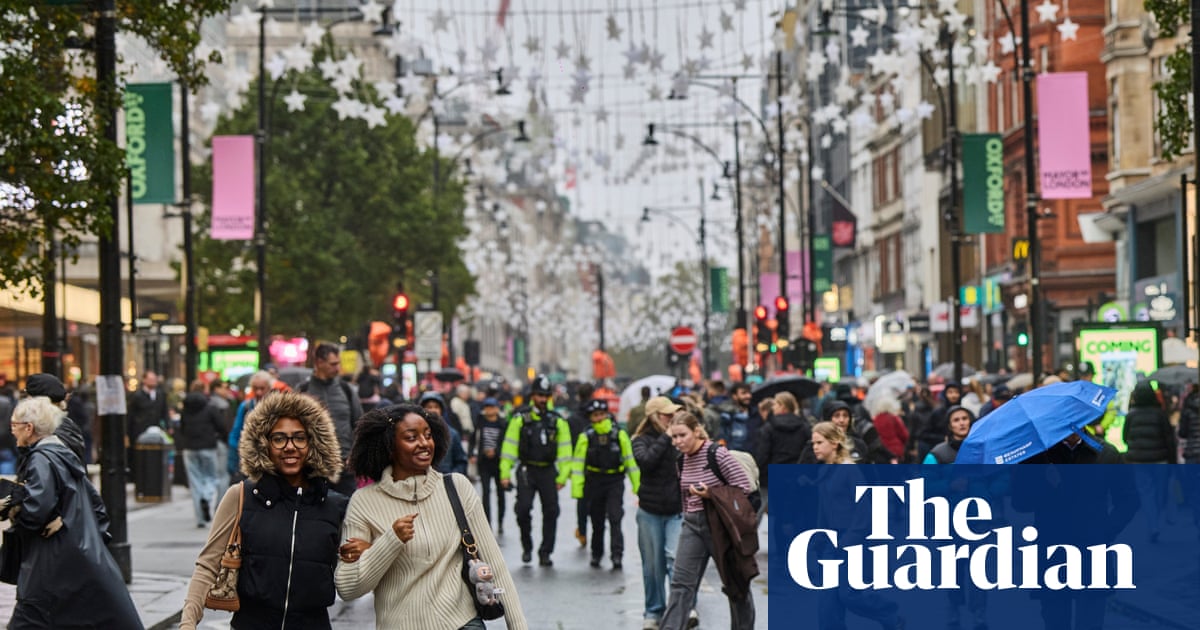
‘It’s a better experience’: shoppers praise Oxford Street pedestrianisation
0 / 39
English
中文
To the east of Oxford Circus, there is chaos. A steady stream of red London buses swing round the last junction before the newly pedestrianised Oxford Street begins. The streets are crammed with pedestrians, some squabbling over who poked whom with their umbrella first.
(暂无翻译) (暂无翻译) (暂无翻译)
To the west, pedestrians walk freely through the temporary bollards on to a green welcome banner rolled along the tarmac, declaring Oxford Street traffic-free.
(暂无翻译)
It may be a wetter Monday morning than London’s mayor would have dreamed of, but Sadiq Khan hailed it a “momentous day”. Almost a kilometre of the capital’s most famous shopping street has now been pedestrianised, banishing the buses, bikes, taxis, e-scooters and pedicabs along with private cars.
(暂无翻译) (暂无翻译)
Shoppers who spoke to the Guardian shared their enthusiasm for Khan’s project, revelling in how the extra space to walk the street and browse the shops meant they were no longer crammed so tightly that they jostled one other off the pavement.
(暂无翻译)
Daniel Te, who had moved to London from the US in July, was so moved by the scene that he whipped out his sketchpad to memorialise the moment. “I’m trying to capture the sheer mass of people going down the street,” he said, observing that despite the pedestrianisation, most people continued to walk on the pavement.
(暂无翻译) (暂无翻译)
“It’s an entirely new place now, isn’t it?” he said. “My first impression was I remember getting off the Oxford Circus tube stop and seeing the scramble crossing and all the people walking around, and I was like, ‘wow, that’s really cool.’ So now to see the whole street become kind of like the scramble crossing is really exciting.” Te added that on a typical day he would avoid the street because it was “too busy”.
(暂无翻译) (暂无翻译)
“Now there’s more space to walk around, I’m more inclined to come,” he said. A former city planner, he considered it “a really big achievement when a street becomes pedestrianised”, adding that he would love to see neighbouring streets become car-free.
(暂无翻译) (暂无翻译)
“Covid taught us a lot about what we can do with our spaces,” he said, noting that although he thought the bus rerouting might make some journeys more inconvenient, “it’s a small price to pay”. Raquel Cox, who was on holiday from Ireland, came to the street after watching a news item on the pedestrianisation.
(暂无翻译) (暂无翻译)
“We couldn’t believe it. We said, ‘We have to go there and experience it first-hand’.” Although she acknowledged there could be negative impacts on the surrounding streets, which will become busier as a result, she felt that as a shopper, “it’s a better experience”. After decades of discussion, the closure to traffic has come into effect in time for the busy Christmas shopping period, although the bigger transformation of the street – a £150m project including trees, seating and level “plazas” for events – will start taking shape from spring 2027.
(暂无翻译) (暂无翻译) (暂无翻译)
Abbas Shigival, who runs a kiosk selling tourist souvenirs at the start of the pedestrianised section, said it would take time to determine the impact on his business, though he thought the morning had been a little busier than usual.
(暂无翻译)
“It’s a more pleasant environment,” he said.
(暂无翻译)
“People are happier because they can walk around.” His views were echoed by Khan – whose first jobs were in retail in stores in the street – in a speech at John Lewis on Monday morning. The mayor said: “We’ve seen over the last couple of decades this street in decline … Pedestrianising the street with great public transport links, more greenery, more seating, will link to a better experience all round.” The permanent plans will depend on feedback in the first phase and testing, and Khan said London “would be closely monitoring these changes to make sure they are working for everyone”. He added: “I want this to be a proof of concept – that investing in people rather than traffic leads to better footfall and spend.” About half of the 1.2-mile (1.9km) street is now vehicle-free, roughly from Oxford Circus station to Marble Arch.
(暂无翻译) (暂无翻译) (暂无翻译)
Many of London’s doubledecker buses will now be diverted into neighbouring roads. Claire Mann, the chief operating officer at Transport for London, said there would still be “plenty of capacity for passengers” and it should not affect reliability.
(暂无翻译) (暂无翻译)
“We’ll be monitoring to see if it does have an impact on ridership – but Bond Street and the Elizabeth Line does give you a way to arrive in style,” she said. Not everyone agrees, however.
(暂无翻译) (暂无翻译)
Ben McMullan, a taxi driver, said traffic was “definitely worse on the surrounding streets, and accessibility is a huge problem”, noting that he had “got stuck in areas I wouldn’t have got stuck in before”. He had already dropped off several customers that morning who had struggled with no direct access to the street by car, including a mother with a pram and a woman with walking difficulties.
(暂无翻译) (暂无翻译)
“I could only get her so far and she was really disappointed,” he said. McMullan feared the change might have a negative impact on his business.
(暂无翻译) (暂无翻译)
“Once people realise they can’t get to where they need to go, I think automatically that just shuts them off from getting in the cab,” he said. Jack* was one of many cyclists stopped by security guards over the course of the day as he cycled down the street, on his way home from a construction job.
(暂无翻译) (暂无翻译)
“I’ll be completely honest with you. I’m not going to listen to no one.
(暂无翻译) (暂无翻译)
I’m going to ride down this road, whether they like it or not,” he said, adding that an alternative route would make his commute longer. “It’s not going to work for me.” He disagreed with pedestrianisation on principle.
(暂无翻译) (暂无翻译)
“We live with loads of low traffic neighbourhoods. It makes it harder for people to actually have vehicles.”
(暂无翻译) (暂无翻译)
仅供学习使用,如有侵权请联系删除 · 查看原文