Is EU putting profits over human rights in Vietnam?
0 / 44
English
中文
The EU and Vietnam are deepening economic and diplomatic ties, but closer cooperation raises concerns about whether Brussels is doing enough to address Hanoi's human rights record, labor standards and trade imbalances.
(暂无翻译)
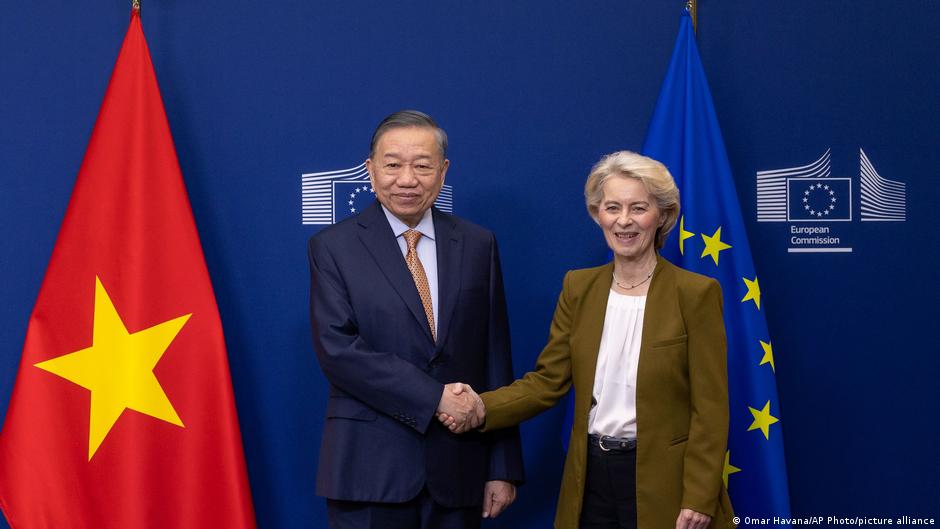
Vietnam's Communist Party chief and president, To Lam, arrived in Brussels on Wednesday for an official visit to the European Union (EU) and Belgium in another sign that relations continue to expand.
(暂无翻译)
The visit comes just days after Vietnam signed a free trade agreement with the European Free Trade Association (EFTA), comprising Norway, Switzerland, Iceland and Liechtenstein.
(暂无翻译)
Trade ties between Vietnam and Europe have deepened in recent years. The EU-Vietnam Free Trade Agreement (EVFTA), which took effect in August 2020, substantially expanded Vietnam's commercial ties with most European states.
(暂无翻译) (暂无翻译)
Amid global tariff wars, the EU-Vietnam relationship "is a welcome advertisement for keeping markets open," Khac Giang Nguyen, a visiting fellow at the ISEAS–Yusof Ishak Institute in Singapore, told DW.
(暂无翻译)
"This is a win-win for both sides," he said. "Vietnam offers Europe an established manufacturing base and another foothold in Asian supply chains. Europe offers Vietnam capital, technology and a large market, helping Hanoi reduce its exposure to American demand and Chinese industrial inputs."
(暂无翻译) (暂无翻译) (暂无翻译)
Vietnam is now the EU's largest goods-trading partner in Southeast Asia and its 14th-largest globally. The EU is Vietnam's fourth-largest trading partner and a major source of foreign investment.
(暂无翻译) (暂无翻译)
Noneconomic relations are also advancing. In January, both sides upgraded ties to a Comprehensive Strategic Partnership — the first such agreement between the EU and a Southeast Asian country.
(暂无翻译) (暂无翻译)
Vietnam has become a key strategic partner for the EU in the Indo-Pacific, Alfred Gerstl, an expert on Indo-Pacific international relations at the University of Vienna, told DW.
(暂无翻译)
"The cooperation is crucial for advancing the EU's economic security agenda and its strategy of de-risking from China," he said, referring to the European Union's efforts to diversify its supply chains and reduce dependence on Chinese manufacturing.
(暂无翻译)
Several EU states have signed defense agreements with Vietnam. Bloc foreign policy chief Kaja Kallas held talks with Vietnamese Foreign Minister Le Hoai Trung on Wednesday to discuss ways to improve security cooperation, including in the South China Sea, where Hanoi is locked in territorial disputes with China.
(暂无翻译) (暂无翻译)
The relationship has also faced difficulties. Questions remain over whether European companies are benefiting sufficiently from Vietnam's economic boom and whether Brussels is overlooking Hanoi's worsening human rights record.
(暂无翻译) (暂无翻译)
Vietnam remains a one-party communist state that severely restricts political opposition, independent journalism and civil society. Rights organizations say repression has intensified under To Lam, who previously headed the country's powerful public security ministry.
(暂无翻译) (暂无翻译)
In an open letter sent this week to European Commission President Ursula von der Leyen and European Council President Antonio Costa, 12 international human rights organizations raised "grave concerns over the Vietnamese government's intensifying repression" and urged EU leaders to demand meaningful reforms.
(暂无翻译)
When negotiating the EVFTA and the accompanying political agreements, Hanoi agreed to obligations on human rights, labor protections and environmental standards.
(暂无翻译)
These included commitments to reform labor legislation to permit independent worker organizations and align domestic regulations more closely with International Labour Organization (ILO) standards.
(暂无翻译)
Rights groups say Hanoi has failed to deliver. Vietnam has still not ratified the ILO convention on freedom of association, and independent trade unions remain prohibited.
(暂无翻译) (暂无翻译)
"The EU has taken no action in response to Vietnam's repeated breaches of its EVFTA-related obligations and pledges; instead, in January it upgraded bilateral relations," the joint letter read.
(暂无翻译)
There are also questions about which Vietnamese companies have benefited most from the EU's trade liberalization.
(暂无翻译)
Large foreign-invested manufacturers and established exporters have been better placed to exploit tariff reductions than smaller domestic businesses, which often lack the resources to navigate Europe's complex import requirements.
(暂无翻译)
Vietnamese exporters also face growing demands from the EU's Carbon Border Adjustment Mechanism and its deforestation regulations, which require businesses in affected sectors to provide more detailed information about their production processes and supply chains.
(暂无翻译)
"It is quite clear that the EVFTA's benefits have been distributed unevenly across sectors, firms and social groups, while political, regulatory, and economic challenges may complicate the next phase of the relationship," Hai Thiem Bui, a researcher at the Stockholm Center for Global Asia, Stockholm University, told DW.
(暂无翻译)
"The next phase of EU-Vietnam trade relations is likely to depend less on tariff liberalization and more on whether Vietnam can adapt to increasingly demanding EU standards concerning labor rights, sustainability, and regulatory governance," he added.
(暂无翻译)
Another challenge concerns how much European businesses are gaining from Vietnam's expanding export economy.
(暂无翻译)
Although the EVFTA has considerably strengthened bilateral commerce, it has been far more successful at increasing Vietnamese exports to Europe than EU sales to Vietnam.
(暂无翻译)
The EU's goods-trade deficit with Vietnam reached €51.7 billion ($57.9 billion) in 2025 — up from roughly €24 billion in 2019.
(暂无翻译)
This imbalance is becoming more conspicuous as Brussels seeks greater economic security and new export opportunities for EU industries.
(暂无翻译)
To view this video please enable JavaScript, and consider upgrading to a web browser that supports HTML5 video Another obstacle is the EU-Vietnam Investment Protection Agreement, signed in 2019, which has still not entered into force.
(暂无翻译)
"We have also seen an uptick in investments by European businesses in Vietnam, despite the lack of an Investment Protection Agreement being in place," Chris Humphrey, executive director of the EU-ASEAN Business Council, told DW.
(暂无翻译)
Germany ratified it in February and Poland followed in April, but France, the Netherlands and several other member states have yet to complete ratification.
(暂无翻译)
The agreement will strengthen legal protections for investors and establish a permanent mechanism for resolving investment disputes, potentially encouraging greater EU investment in Vietnam.
(暂无翻译)
"With a new government in Vietnam pursuing an ambitious legislative program but with an overall target of maintaining Vietnam's extraordinary growth path, we would expect trade to continue to flourish," Humphrey said.
(暂无翻译)
"That said, many European businesses are looking carefully at what the legislative program may bring in terms of reform," he added.
(暂无翻译)
For Brussels, the next phase of relations is about ensuring that EU businesses benefit from that growth, while demonstrating that its commitments to human rights and sustainable trade are more than diplomatic promises.
(暂无翻译)
To view this video please enable JavaScript, and consider upgrading to a web browser that supports HTML5 video
(暂无翻译)
仅供学习使用,如有侵权请联系删除 · 查看原文