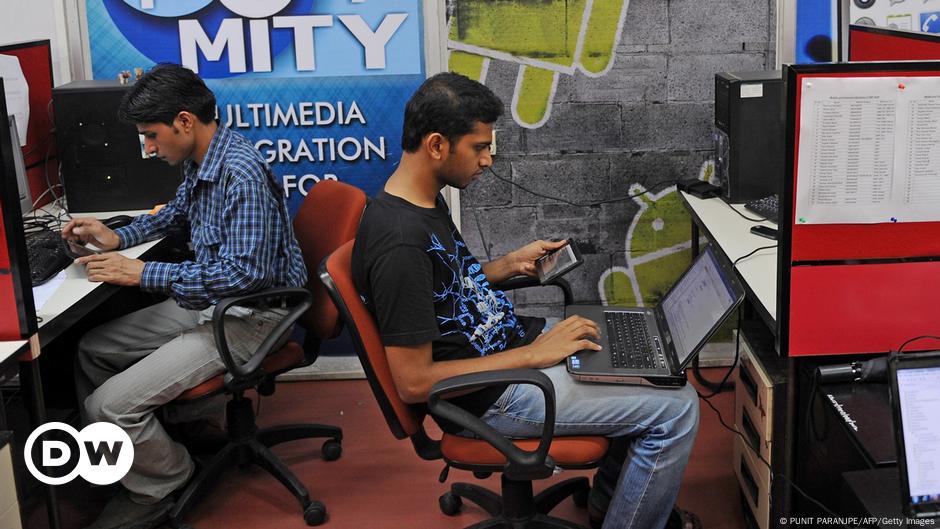
India's young workers have a new colleague: AI
0 / 50
English
中文
Artificial intelligence is changing the way Indian workplaces operate — raising questions about productivity, skills and entry-level jobs.
(暂无翻译)
Across India, young workers are increasingly turning to artificial intelligence (AI) to speed up routine tasks, whether researching news stories, translating copy, analyzing business data or sorting legal documents.
(暂无翻译)
But the technology can get things wrong, and relying on it too heavily carries risks.
(暂无翻译)
Journalist Farah Kazmi, 28, who works for a news portal in New Delhi, used AI while reporting on rules governing stray animals and feeding them in gated communities. She asked an AI model to find the Supreme Court's latest guidelines, earlier court rulings and recent dog-bite cases.
(暂无翻译) (暂无翻译)
"Since it can take quite a lot of time to search Google for specific articles about court rulings, previous judgments or recent dog-bite cases, I asked AI to find them for me," Kazmi told DW.
(暂无翻译)
It gave her a starting point for relevant articles and cases, which she then read and cross-checked herself.
(暂无翻译)
To view this video please enable JavaScript, and consider upgrading to a web browser that supports HTML5 video Kazmi also uses AI to translate English copy into Hindi for the Hindi news team, and Hindi quotes into English.
(暂无翻译)
But translations need careful checking, Kazmi said, pointing out that in one case, AI interpreted the name "Suraj" as "sun," changing the sentence's meaning. "Before using AI, I mostly relied on Google Translate.
(暂无翻译) (暂无翻译)
It was more literal and did not always understand the context. AI gives a much better and more context-based translation, although it still needs to be checked and corrected," she said. AI has not fundamentally changed journalism, which still involves talking to people and reporting from the field, Kazmi said.
(暂无翻译) (暂无翻译) (暂无翻译)
"Ultimately, I see AI as a tool that helps with research and saves time," she said, "but the actual verification and reporting still has to be done by the journalist."
(暂无翻译)
Yajatt Misra, 28, business strategy and international markets manager at Kanoria Chemicals and Industries, uses AI to analyze data, summarize large volumes of information, prepare first drafts and structure ideas.
(暂无翻译)
It also helps him turn financial and business information from different sources into management updates and presentations.
(暂无翻译)
"Things like summarizing information, preparing first drafts, analyzing data and putting together presentations take less time now," Misra told DW.
(暂无翻译)
Misra said the challenge was knowing when to trust the output.
(暂无翻译)
AI can miss business context or get details wrong, so its numbers, logic and conclusions need checking. "There is less need to spend time on repetitive tasks and more focus on analysis, problem-solving and providing useful insights to the business," Misra said.
(暂无翻译) (暂无翻译)
To view this video please enable JavaScript, and consider upgrading to a web browser that supports HTML5 video Rakshanda Deka, a 30-year-old lawyer, uses AI to sort large bundles of client documents chronologically or by theme and produce a first list of important dates.
(暂无翻译)
Some systems link information to the original documents so lawyers can check the source.
(暂无翻译)
AI can also help prepare standard applications and petitions using a lawyer's own format and style. "If used sensibly, and without outsourcing the substantive legal thinking, AI is basically like having a sincere fresher or junior colleague," Deka told DW.
(暂无翻译) (暂无翻译)
But AI can confidently produce false information — making human checking essential.
(暂无翻译)
"AI often gives you false information dressed up very confidently as fact," Deka said.
(暂无翻译)
"So it is imperative that you double-check everything."
(暂无翻译)
Deka is concerned that some young lawyers may use AI as a substitute for their own thinking. "A lot of the youngest lawyers are beginning to use AI as a substitute for themselves," she said.
(暂无翻译) (暂无翻译)
The use of AI is widespread among younger Indians, with a survey by Deloitte this year finding that 93% of Gen Z respondents and 95% of millennial respondents used artificial intelligence in their day-to-day work. An Emeritus survey found that 82% of respondents aged 15 to 28 used AI tools at least weekly to learn or develop new skills.
(暂无翻译) (暂无翻译)
To view this video please enable JavaScript, and consider upgrading to a web browser that supports HTML5 video Dimple Khubchandani, founder of recruitment firm Synoverge Consultants, told DW that employers increasingly want young professionals who can think critically, solve problems and check AI-generated work rather than simply handle basic research or drafting.
(暂无翻译)
"AI is not necessarily eliminating entire job categories, but it is creating leaner teams and raising expectations," she said.
(暂无翻译)
Khubchandani said a marketing agency that once might have hired four junior copywriters could now hire one to use AI for initial drafts, leaving more time to edit, refine the tone and shape strategy.
(暂无翻译)
"AI is raising the baseline capability expected from employees on day one," she said.
(暂无翻译)
Tata Consultancy Services (TCS), one of India's largest IT services companies, said in its 2025-26 annual report that it had scaled up its "Human+AI" operating model and was embedding artificial intelligence across services and software development.
(暂无翻译)
Shrijay Sheth, co-founder of LegalWiz.in, an online legal and compliance service, sees the shift across the economy.
(暂无翻译)
"AI's impact on job profiles isn't an anticipation," Sheth told DW.
(暂无翻译)
"It is a reality now.
(暂无翻译)
From basic research to strategy, operations, marketing, design and development, AI is changing how work gets done."
(暂无翻译)
In software development, Sheth said, developers are spending less time writing code from scratch and more time monitoring, testing and refining AI-generated output. "Business, product and problem-solving ability, coupled with skills around working with AI platforms, is valued over mere technical ability to work with any particular coding language," Sheth said. To view this video please enable JavaScript, and consider upgrading to a web browser that supports HTML5 video The question of what happens to entry-level work is becoming harder to ignore.
(暂无翻译) (暂无翻译) (暂无翻译)
A 2025 report by NITI Aayog, the Indian government's public policy think tank, cites data from the Center of Advanced Study in India suggesting that more than 60% of formal-sector jobs could be susceptible to automation by 2030 — particularly in IT and business-process services.
(暂无翻译)
It also warns of slower hiring for entry-level software engineers and identifies junior quality-assurance and Level 1 support roles as vulnerable.
(暂无翻译)
The World Bank's October 2026 India Development Update says AI's long-term impact on the country's labor market remains uncertain.
(暂无翻译)
India could benefit from its technical workforce, IT sector and digital infrastructure, the report found, but stronger workforce skills and wider access to AI capabilities will be needed if the gains are to be broadly shared.
(暂无翻译)
"The productivity enhancement and job loss are both real," Sheth said.
(暂无翻译)
Deka said lawyers would increasingly be distinguished by how rigorously they check AI's work.
(暂无翻译)
"I think the differentiation is increasingly coming from the thoroughness of post-AI verification and confirmation," she said.
(暂无翻译)
仅供学习使用,如有侵权请联系删除 · 查看原文