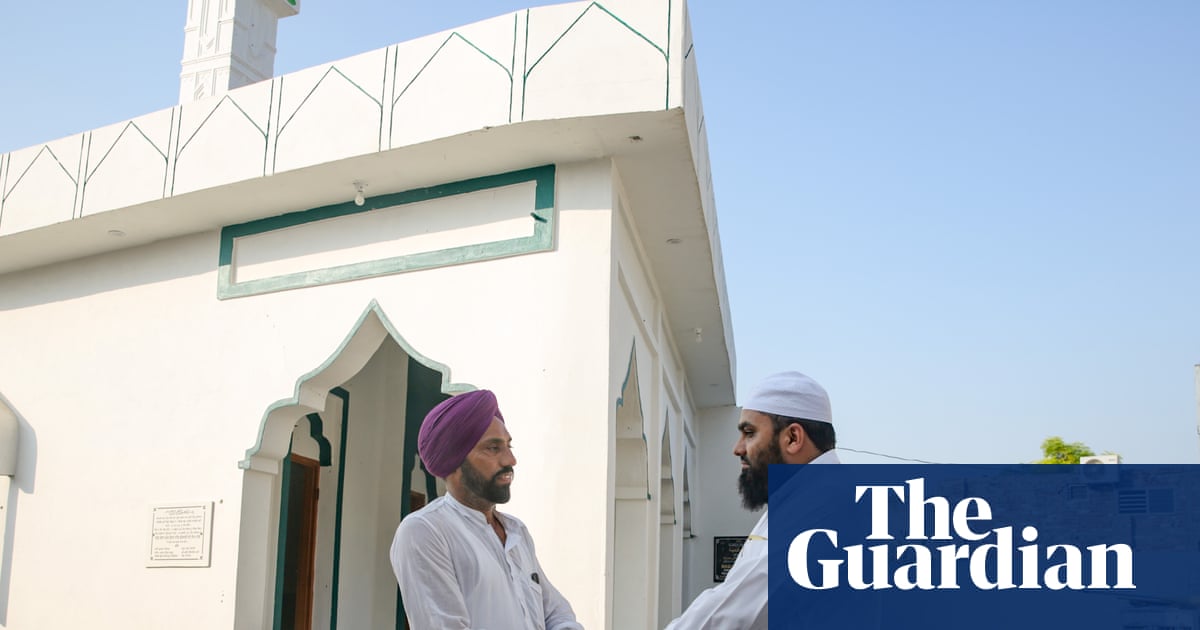
How rebuilding old mosques is bringing Sikhs, Hindus and Muslims together in Punjab
0 / 32
English
中文
Gajju Khan is smiling as he sits in an unfinished building in the northern Indian state of Punjab in the late afternoon. The 87-year-old is hopeful that before he dies he will hear the azaan, the Muslim call to prayer, echo across his village once again when the mosque is completed.
(暂无翻译) (暂无翻译)
The last time he heard it here was when he was eight years old, living with his parents in Tira Maloya, a village in Chandigarh, not far from where he lives now.
(暂无翻译)
He is also excited because the mosque has been funded almost entirely by the Sikhs and Hindus living in his village of Jakhiwal, in Fatehgarh Sahib district. Even though he fondly remembers how Sikh neighbours sheltered him and his brothers when brutal sectarian violence erupted during partition in 1947, he never expected a house of worship to be rebuilt for the 18 Muslim families who remain in the village.
(暂无翻译) (暂无翻译)
“This was my maternal home. My parents sent my two brothers and me here to save us from the bloodshed – they were killed back in our village,” says Khan. “Sikhs hid us from the patrols of men with sticks and burning torches.” Khan reserves his deepest gratitude for Bibi Rajinder Kaur, 77, a Sikh villager who persuaded her grandson to donate a parcel of their farmland to build a mosque.
(暂无翻译) (暂无翻译) (暂无翻译)
She did so, she says, because every other faith had a place to gather, while local Muslims had none. “There is no deed better than giving someone a place to worship,” Kaur says.
(暂无翻译) (暂无翻译)
“Also, it felt like we needed to appease God for the blood this land had seen. The Muslims in our village had to travel 4km [2.5 miles] to another village just to pray.” Bibi Rajinder Kaur, a Sikh, donated family land to build a mosque in her village. ‘There is no deed better than giving someone a place to worship,’ she says Gajju Khan, who hopes to live long enough to see the mosque in his village completed During the partition of British India, the border severed Punjab in two, unleashing catastrophic communal blood-letting and forced migrations that virtually emptied the eastern, Indian side of the region of its Muslim population. Hundreds of village mosques were abandoned, desecrated or turned into cattle sheds and storage units.
(暂无翻译) (暂无翻译) (暂无翻译)
But over the past decade, several rural Sikh and Hindu communities have quietly stepped forward to restore these places of worship.
(暂无翻译)
Even in villages without a Muslim population, people have invited Muslim farmhands and clerics from nearby districts to pray in these newly revived mosques.
(暂无翻译)
About 50 miles from Jakhiwal, in Sangrur district’s Punawal village, Jaspal Sharma, who comes from a family of Hindu priests, donated his land for the construction of a new mosque and hosted a feast for the entire village at its inauguration in February. Sharma, 48, says the donation was about neighbourly duty.
(暂无翻译) (暂无翻译)
The village has 550 households, of which just a very small proportion are Muslim. Jaspal Sharma says donating some of his land to build a mosque was a neighbourly duty The new mosque in Malerkotla, Punjab, welcomes worshippers for evening prayers “It’s right opposite our house, so the sound of prayers five times a day creates a lively atmosphere.
(暂无翻译) (暂无翻译)
We like it,” says Sharma.
(暂无翻译)
“And it wasn’t just us; everyone in the village, Hindus and Sikhs together, contributed what they could. Some gave money; others donated bricks and cement.” For Sukhjinder Singh Pandher and his brother, restoring a local shrine in Malerkotla’s Umarpura village was an act of filial reverence.
(暂无翻译) (暂无翻译)
Their grandfather fled west Punjab during partition to settle in India.
(暂无翻译)
“Nobody is treated as different here,” says Pandher, sharing a cup of tea with his Muslim neighbours on the bare floor of the restored mosque.
(暂无翻译)
“Eid and Gurpurab [Sikhs’ most holy festival] are celebrated by both communities with the same fervour. Sadna Qasai, one of the many mosques in Punjab that fell into ruin after partition “We live as one and no matter what happens in the rest of the country, the mood here is that of love and unity. Punjab’s conscience cannot tolerate cruelty against a being, irrespective of caste and religion,” he says. Pandher points to the syncretic traditions and blending of cultures that are deeply rooted in Punjabi history, noting the popular belief that the 16th-century Sufi saint Hazrat Mian Mir was invited to lay the foundation stone of Sikhism’s holiest site, the Harmandir Sahib, or Golden Temple, in Amritsar.
(暂无翻译) (暂无翻译) (暂无翻译) (暂无翻译)
Inspired by the former shahi, or chief, imam of Punjab, Maulana Habib-ur-Rehman Sani Ludhianvi, non-Muslim villagers have contributed to more than 165 such mosques in the past nine years. Sikh men in Punjab’s villages have been coming together to fund and help build or revive old mosques “Partition tore at the natural fabric of Punjab,” says the current shahi imam, Maulana Muhammad Usman Rehmani Ludhianvi, who succeeded his father in 2021.
(暂无翻译) (暂无翻译)
“This state itself is an inquilab [revolution]. Online, there is immense polarisation, but on the ground in our villages, ordinary people are still choosing to protect each other.”
(暂无翻译) (暂无翻译)
仅供学习使用,如有侵权请联系删除 · 查看原文