How a lifelong Republican came to lead the data center battle in Ohio
0 / 75
English
中文
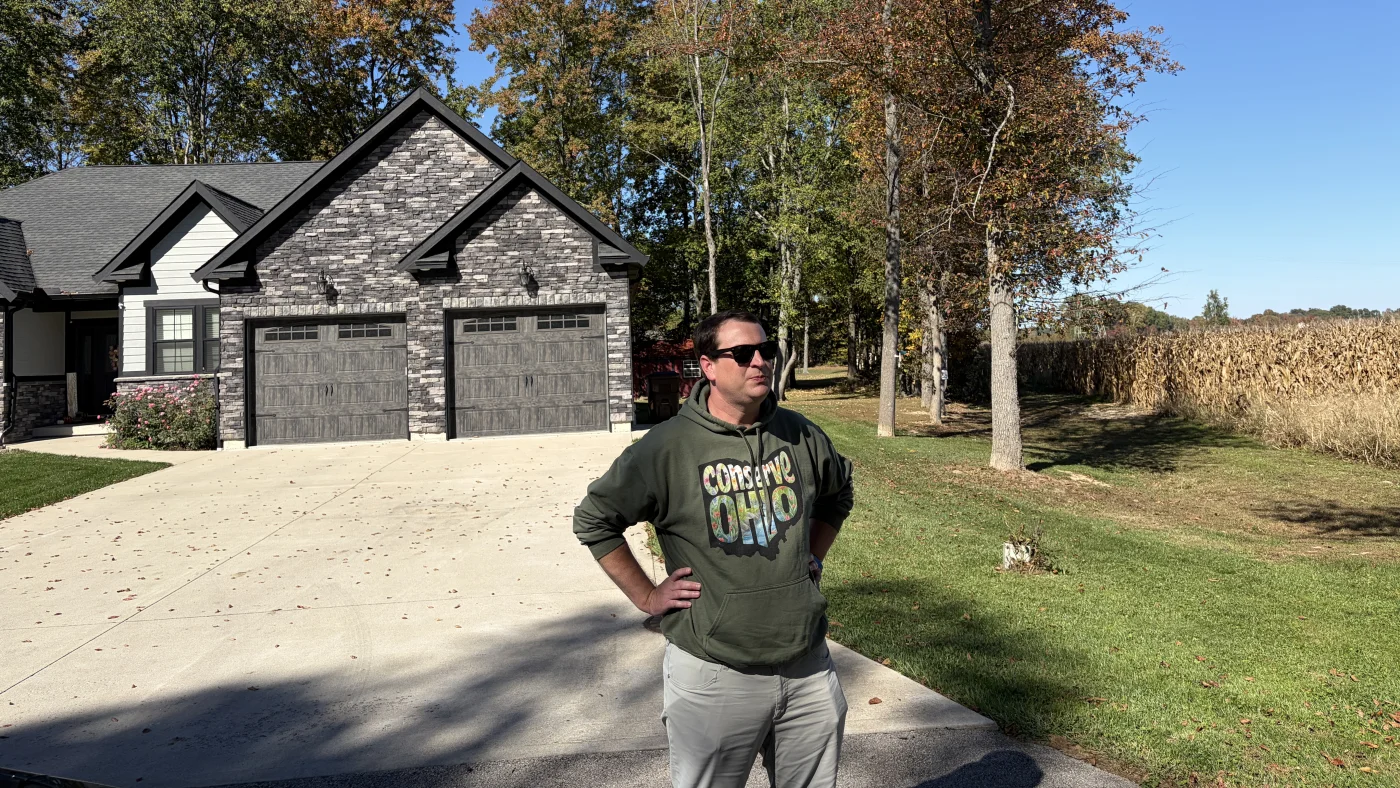
Nick Owens, an attorney in Brown County, Ohio, stands at the edge of a Mt. Orab neighborhood next to farmland that has been sold to a data center developer. Owens is leading an effort to halt the buildout of hyperscale data centers in communities like this one. Andrea Hsu/NPR hide caption Stay up to date with our Politics newsletter, sent weekly. MT.
(暂无翻译) (暂无翻译) (暂无翻译) (暂无翻译)
ORAB, Ohio — The data center mystery in this rural exurb of Cincinnati has consumed Nick Owens.
(暂无翻译)
The lifelong Republican and self-described small-town attorney has spent countless hours trying to figure out what's going on with 1,000 acres of farmland and trees that property records show were sold to a data center developer in 2024 and 2025. In a few spots, the data center property runs right up against beautiful two-story homes.
(暂无翻译) (暂无翻译)
"This is the Ohio that people brag about.
(暂无翻译)
This is the Ohio people love.
(暂无翻译)
This is the small town charm," he says. "Living in the rural area, but getting the benefits of a nice, lovely neighborhood." Some of the most coordinated opposition to data centers anywhere in the country grew out of what happened in secrecy in this village of 4,300 people, a short drive up a country road from Owens' home. Nondisclosure agreements have stymied Owens' efforts to learn more.
(暂无翻译) (暂无翻译) (暂无翻译) (暂无翻译)
But along his quest, he crossed paths with another local attorney and a real estate agent who were equally alarmed.
(暂无翻译)
Together, they mobilized a network of volunteers in nearly all 88 counties in the state. They are Democrats, Republicans and Independents. They called themselves Conserve Ohio. "We all share the same ethos and the same passion for preserving our way of life, preserving the future of Ohio, frankly, from the hyperscale data center invasion," says Owens. "It's really beautiful."
(暂无翻译) (暂无翻译) (暂无翻译) (暂无翻译) (暂无翻译)
This fall, the group is behind ballot initiatives in 10 communities that would amend local charters to prohibit the construction of large-scale data centers — the kind used to power artificial intelligence. It's an effort that goes beyond the temporary pauses that hundreds of municipal and county governments have embraced.
(暂无翻译) (暂无翻译)
"All too often you hear from the politicians, 'Well, the community should have a say,'" says Owens. "We're going to find out in ten communities whether or not the communities want them."
(暂无翻译) (暂无翻译)
Meanwhile, the grassroots group is working on a more ambitious undertaking: a petition for an amendment to the state constitution that would ban large-scale data centers statewide. Their goal is to put that to Ohio's voters in 2027.
(暂无翻译) (暂无翻译)
It's been more than a decade since tech companies first came to Ohio, drawn by the state's inexpensive and abundant land, its energy infrastructure and its generous tax breaks. That combination paved the way for some of the fastest data center growth in the country.
(暂无翻译) (暂无翻译)
Now, despite the economic benefits — considerable tax revenue, money for schools, numerous construction jobs and a smaller number of permanent jobs — no one seems to want a computing campus in their backyard, especially one shrouded in secrecy. Signs opposing data centers outnumber campaign signs in a neighborhood in Mt. Orab, Ohio.
(暂无翻译) (暂无翻译)
Andrea Hsu/NPR hide caption "Should the school have extra money or the local government have extra money so we have a constant hum and ridiculous amounts of emissions and pollution?"
(暂无翻译)
Owens says, pointing out that hyperscale data centers will require new power plants. "Our community is not for sale."
(暂无翻译) (暂无翻译)
Pressed to consider whether the state should forgo all opportunities, Owens says he'd entertain the idea of putting data centers on old industrial sites, where they'd be buffered from people. "If we're going to have data centers, those are the prime places," he says, while acknowledging that it'd be cheaper and easier for a developer to build on pristine farmland than on an old coal site. "I don't know if there are enough brownfield sites, but shouldn't we start with those first?"
(暂无翻译) (暂无翻译) (暂无翻译)
In recent months, candidates running for statewide office in Ohio have been trying to convince voters that they hear their concerns — even as they stop short of backing the kind of sweeping moratorium data center opponents are seeking.
(暂无翻译)
Conserve Ohio has not endorsed any of them. Until recently, data center projects weren't all that controversial, in part because they were smaller and weren't being built for AI.
(暂无翻译) (暂无翻译)
But as the issue has gained traction, it's become a hot topic in the midterms, including in the tight race to fill a U.S.
(暂无翻译)
Senate seat.
(暂无翻译)
Former Democratic Senator Sherrod Brown has cast his opponent, the incumbent Republican Senator Jon Husted, as "the face of data centers."
(暂无翻译)
Brown has been reminding voters that as lieutenant governor, Husted welcomed tech companies to Ohio and championed their data center investments. Meanwhile, Husted has accused Brown of hypocrisy, pointing to Brown's past support for data centers. Husted has also introduced his own solution, pushing a bill in Congress aimed at getting data centers to pay for power grid upgrades and other costs associated with their massive energy use. Senate Democrats have blocked the bill, calling it toothless, prompting Husted to accuse the Democrats of not caring or helping.
(暂无翻译) (暂无翻译) (暂无翻译) (暂无翻译)
These political gestures have not persuaded Linda Moodie, an independent who's been volunteering with Conserve Ohio.
(暂无翻译)
She doesn't trust that any of the candidates running for statewide office "will do the right thing" if elected, which is to give the people a say in the data center buildout. "It's really something that I think a lot of us didn't see coming, and all of a sudden there's just an influx of them," she says.
(暂无翻译) (暂无翻译)
While Moodie wonders if all the talk on the campaign trail is simply to get votes, she says she will cast her ballot for Brown, who she thinks has been talking about data centers the longest. Linda Moodie (right), a volunteer with Conserve Ohio, collects signatures for a petition to ban large-scale data centers statewide at a Halloween event in Fairfield, Ohio, on Oct. 22, 2026.
(暂无翻译) (暂无翻译)
Andrea Hsu/NPR hide caption And meanwhile, between now and election day, she's seizing every opportunity to collect signatures to get the statewide ban on the ballot next year.
(暂无翻译)
On a recent evening, she set up a booth at the "Halloween on the Green" celebration in the Cincinnati suburb of Fairfield.
(暂无翻译)
She handed out candy to kids and clipboards with the petition to parents. Both were enthusiastically received.
(暂无翻译) (暂无翻译)
"The closer it hits to home, the more people that are going to want to do something," says Moodie.
(暂无翻译)
Two years ago, Owens served as a Trump delegate at the Republican National Convention. He won't say how he's voting this fall, but he says no doubt the data center issue, along with $6 diesel, have dampened Republican enthusiasm. Throughout Mt.
(暂无翻译) (暂无翻译) (暂无翻译)
Orab, the absence of campaign yard signs is notable.
(暂无翻译)
"Two years ago you would have seen Donald Trump signs left and right," says Owens. This county, like much of rural Ohio, voted 80% for President Trump in 2024.
(暂无翻译) (暂无翻译)
"You always have depressed votes in the midterms," says Owens. "But I think the enthusiasm gap for Republicans in particularly rural areas is going to be a lot more pronounced… than any type of enthusiasm gap for Democrats in the cities."
(暂无翻译) (暂无翻译)
Trump's belittling of data center opponents isn't helping, he says, citing recent comments the president posted to his social media platform Truth Social.
(暂无翻译)
"The only reason that communities throughout the U.S.A. should not want Data Centers is if they want to end up being backwards and poor.
(暂无翻译)
If they want to be successful and rich, with far lower taxes and jobs all over the place, let Data Reign," Trump wrote. "If we kill the Golden Goose, you will only have yourselves to blame."
(暂无翻译) (暂无翻译)
Owens calls the president's statements "tone deaf."
(暂无翻译)
"I mean, no one wants to be poor or backwards," he says. "I want our regular way of life." Construction at the Mt.
(暂无翻译) (暂无翻译) (暂无翻译)
Orab site hasn't yet begun.
(暂无翻译)
It's not clear when it will. Owens says because of nondisclosure agreements, people who live here know nothing.
(暂无翻译) (暂无翻译)
For now, standing at the edge of the data center property on a crisp fall day, it's nearly silent but for the birds.
(暂无翻译)
仅供学习使用,如有侵权请联系删除 · 查看原文