Brazil's left-wing President Lula elected for fourth term
0 / 41
English
中文
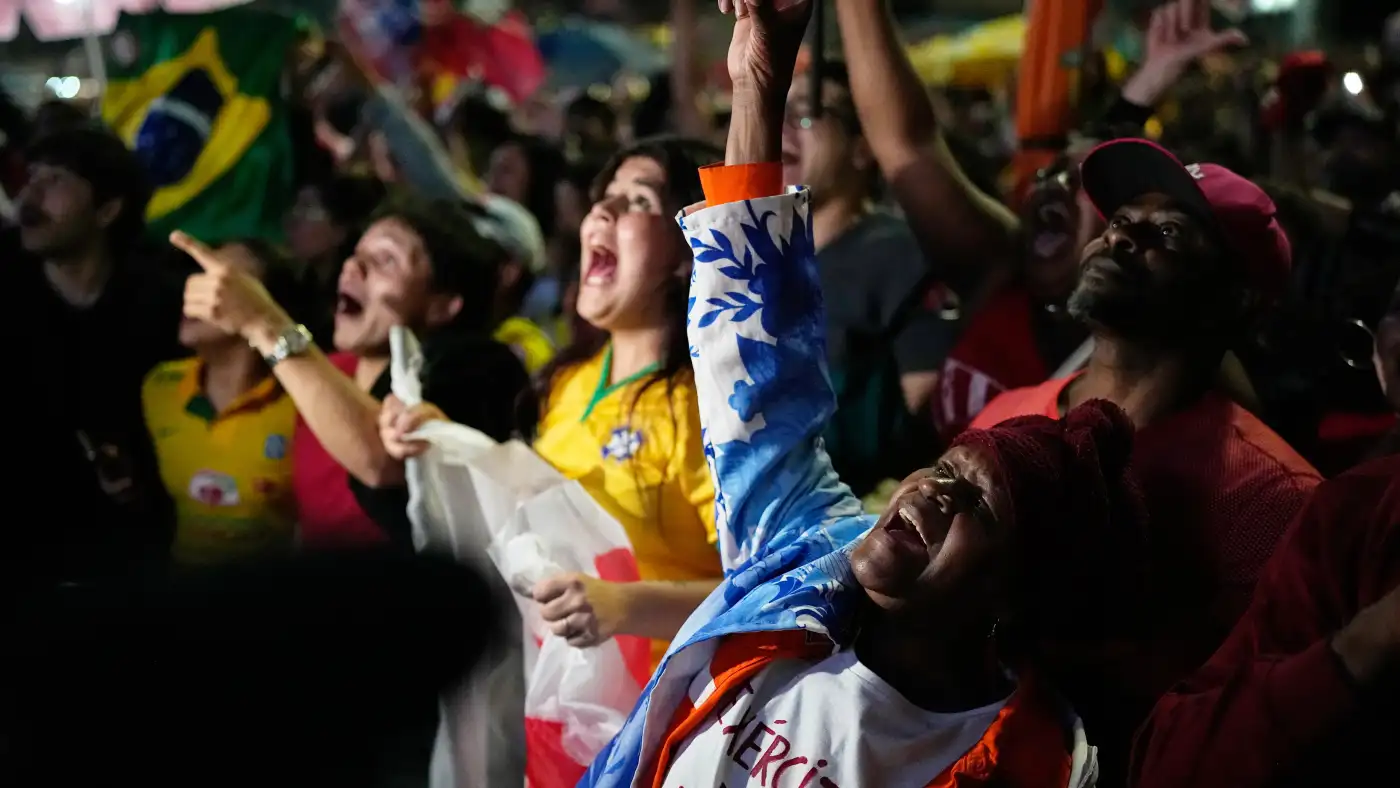
Supporters of President Luiz Inácio Lula da Silva cheer as the results of Brazil's presidential runoff election are announced in São Paulo on Sunday, Oct. 25, 2026. Natacha Pisarenko/AP hide caption BRASILIA, Brazil — In a stunning political comeback, Luiz Inácio Lula da Silva has been elected president of Brazil, according to official results from Sunday's runoff election, with more than 96% of the votes counted.
(暂无翻译) (暂无翻译)
Lula secured more than 51% of the vote, defeating Sen.
(暂无翻译)
Flávio Bolsonaro, who received more than 48%. The result marks a historic moment in Brazil's democratic era.
(暂无翻译) (暂无翻译)
Since democracy was restored in 1989, no candidate who failed to win the first round of voting has gone on to win the presidency in the second round. The victory also adds another chapter to Lula's long political career, securing him a fourth, nonconsecutive presidential term.
(暂无翻译) (暂无翻译)
Lula, who turns 81 on Tuesday, will be among the oldest sitting leaders in the Americas, alongside President Trump and Nicaraguan President Daniel Ortega, both 80. In a speech to ecstatic supporters in São Paulo, Lula said the election was a "defeat of denialism.
(暂无翻译) (暂无翻译)
A defeat of lies." "I want to thank the Brazilian people for this generosity they have shown me for so long, to thank the youth who took to the streets to defend democracy, and the elders who went to vote," Lula told the crowd.
(暂无翻译) (暂无翻译)
President Luiz Inacio Lula da Silva addresses supporters after winning a fourth term in the presidential runoff in , Brazil, Sunday, Oct. 25, 2026.
(暂无翻译)
Andre Penner/AP hide caption Lula's victory bucks a broader rightward shift across Latin America in recent years. In a pointed message to Trump, Lula declared that Brazil would not accept being "anyone's backyard."
(暂无翻译) (暂无翻译)
Election day unfolded chaotically. Around midday, Lula's campaign requested an extension of voting hours, arguing that some local governments had reduced bus services, making it harder for voters to reach polling stations.
(暂无翻译) (暂无翻译)
Bolsonaro also sought an extension, citing heavy rain in some states. Supreme Court Justice Cristiano Zanin extended voting by two hours, to 7 p.m., but some polling stations had already deactivated their electronic voting machines and could not resume voting. Speaking briefly to journalists outside his home in Brasilia, Bolsonaro called the result "inexplicable" and said he would seek to annul the vote.
(暂无翻译) (暂无翻译) (暂无翻译)
"I will not give up on my Brazil, and I hope you won't give up either," he said.
(暂无翻译)
Bolsonaro, 45, had campaigned on closer ties with President Trump and pledged to pardon his father, former President Jair Bolsonaro, who is serving a 27-year sentence under house arrest for plotting a coup to overturn his 2022 election defeat to Lula. Opposition presidential candidate Sen.
(暂无翻译) (暂无翻译)
Flavio Bolsonaro speaks after the presidential runoff in , Brazil, Sunday, Oct. 25, 2026.
(暂无翻译)
Eraldo Peres/AP hide caption Brazilians showed little enthusiasm for street campaigning in the early months. But Bolsonaro's first-round finish on Oct. 4 energized the contest, and in recent days supporters of both candidates have filled rallies and flooded social media in an effort to sway voters. In the end, Lula's message of continuity and a focus on social spending prevailed.
(暂无翻译) (暂无翻译) (暂无翻译)
"I think people woke up about the risk of a Bolsonaro government after the first round, and the mobilization made a difference," said Alessandra Miguel, a 35-year-old spa worker who voted for Lula in Rocinha, a favela in Rio de Janeiro. Lula rose to national prominence as the leader of a metalworkers' union that organized strikes that helped bring down Brazil's dictatorship in the 1980s.
(暂无翻译) (暂无翻译)
Unions and progressive Catholic activists joined forces at the time to form the Workers' Party, which Lula has now represented in seven presidential elections.
(暂无翻译)
During Lula's first two terms in office, from 2003 to 2010, Brazil's economy boomed, and millions of Brazilians rose out of poverty.
(暂无翻译)
But many voters turned their backs on the party when Lula and other leaders became embroiled in corruption scandals in the 2010s. Lula himself was jailed, though his convictions were later overturned on procedural grounds.
(暂无翻译) (暂无翻译)
On foreign policy, Lula has worked to boost the political influence of countries in the Global South as a founding member of the BRICS group, a grouping of major emerging economies that includes Brazil, China, Russia, India and South Africa. He has argued that Brazil should maintain friendly relations with all major world powers, though his ties with China and Russia have sometimes led him to clash with Washington. Supporters of President Luiz Inacio Lula da Silva celebrate after he wins a fourth term in the presidential runoff in Rio de Janeiro, Brazil, Sunday, Oct. 25, 2026.
(暂无翻译) (暂无翻译) (暂无翻译)
Silvia Izquierdo/AP hide caption Lula's approval rating rose after he stood up to Trump, but his disapproval rating remained higher than his approval rating at the start of the election season. Brazil's economic growth has been slower than during Lula's first two terms, and many Brazilians felt he had not done enough to address crime and public security.
(暂无翻译) (暂无翻译)
During the campaign, Lula sought to address those concerns by proposing a ban on sports betting, announcing a debt renegotiation program and backing tougher penalties for minors who commit crimes. He will govern a sharply divided country.
(暂无翻译) (暂无翻译)
Brazilian political scientist Jairo Nicolau, who studies presidential elections, said one of the most striking features of this year's contest was the rigidity of Brazilians' political allegiances. Unlike in past years, Nicolau said, "people's identity of belonging to a tribe became more important than how they view different policy options."
(暂无翻译) (暂无翻译)
仅供学习使用,如有侵权请联系删除 · 查看原文