Australia must recruit hundreds more to crew Aukus submarines, retired admiral warns
0 / 30
English
中文
Australia faces an uphill battle to recruit and train enough naval personnel to serve on submarines planned for the future fleet of nuclear-powered vessels under the controversial $368bn Aukus deal, a retired admiral has warned.
(暂无翻译)
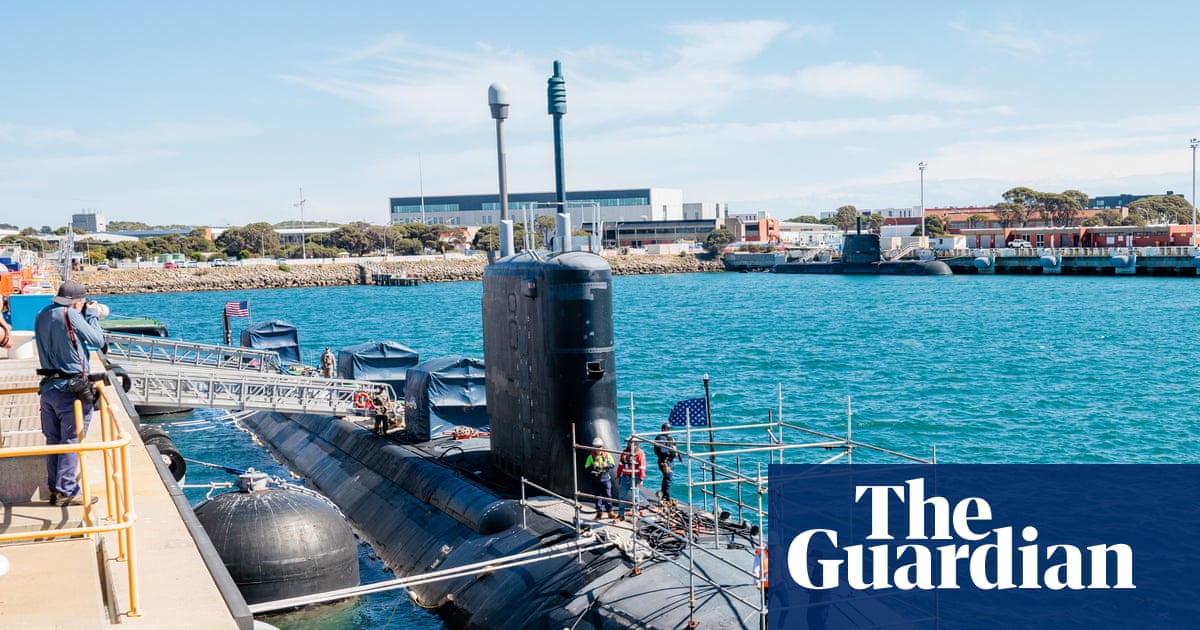
As the Virginia-class submarine USS Colorado arrived at HMAS Stirling south of Perth on Tuesday for a month of routine maintenance and to help build Australian expertise, retired admiral Peter Briggs said more people needed to be enrolled in the navy’s submarine program.
(暂无翻译)
As part of a $368bn trilateral defence deal, Australia will acquire between three and six Virginia-class, nuclear-powered submarines from the United States to replace its five diesel-electric Collins-class vessels, which are becoming obsolete.
(暂无翻译)
The new submarines are much bigger and require up to 134 crew – almosttwice the number needed for the Collins class.
(暂无翻译)
The Royal Australian Navy says it has 230 personnel in various stage of the US nuclear-powered submarine training pipeline.
(暂无翻译)
“Of these, approximately 145 have completed US Naval nuclear power training and are now building experience training on US Navy SSNs [a hull classification for nuclear-powered submarines],” a navy spokesperson said.
(暂无翻译)
“By 2030, we expect to have 400 Royal Australian Navy officers and sailors trained and ready to serve.” But Briggs urged a more intensive recruitment plan to crew the bigger boats.
(暂无翻译)
“We have got to triple the size of the submarine arm and we’ve got to train them in nuclear skills,” he said.
(暂无翻译)
“You are heading toward needing a submarine arm of 3,000, that’s the hill you have to climb.” About 850 submariners are qualified to operate Collins-class vessels.
(暂无翻译)
The Virginia-class boats are intended to bridge the transition from the Collins-class fleet to the future SSN-Aukus submarine, an even bigger design being developed by Australia and the UK.
(暂无翻译)
“The personnel side is a huge issue but it’s not the only one,” Briggs said.
(暂无翻译)
The former submariner argued that maintaining two different submarine types would add complexity to training, logistics, maintenance and spare-parts arrangements.
(暂无翻译)
The Australian government did not respond to questions about recruitment targets and whether a workforce development program was on track.
(暂无翻译)
Recruitment is further complicated by the need for more than a dozen different trades, from radio and sonar operators to cooks and electricians.
(暂无翻译)
After spending the next month is Perth, the USS Colorado will return to the city’s waters again in late 2027 as part of the Submarine Rotational Force-West program, which is designed to help Australia build the skills and infrastructure to operate its own nuclear fleet.
(暂无翻译)
From 2027, the program will see up to four US and one UK nuclear-powered submarine rotate through HMAS Stirling.
(暂无翻译)
Paul Johnson, HMAS Stirling fleet base west commodore, said the USS Colorado maintenance period would be used to “practise and test our procedures across a range of nuclear-related operational scenarios”.
(暂无翻译)
Officials stressed that no radiological material would be transferred during the maintenance period and that nuclear-related exercises would be simulated.
(暂无翻译)
Late last year, Senate estimates heard that US submarines carrying nuclear weapons could rotate through Australian ports despite a non-proliferation commitment.
(暂无翻译)
The USS Colorado captain, Justin Reeves, said the US government would not “confirm or deny the presence of nuclear weapons on specific platforms”.
(暂无翻译)
Colorado was built in 2018 and arrived this week carrying conventional weapons, including four torpedoes and four “payload tubes” that can be used to house and launch weapons.
(暂无翻译)
It took two weeks to travel to Perth from Pearl Harbor in Hawaii with 160 men and no women aboard.
(暂无翻译)
A sign labelled “Berth Rules”, taped to the wall near the submarine’s entryway, listed “Don’t be stinky” as the crew’s top priority once they reach port.
(暂无翻译)
The demands of living and working in confined spaces for extended periods presents another recruitment challenge for officials.
(暂无翻译)
Sleeping arrangements can involve bunks stacked three high, while “hot racking” allows three sailors to share two beds by rotating their sleeping schedules around watch duties. In some circumstances, and when accommodation is limited, sailors may sleep in torpedo rooms.
(暂无翻译) (暂无翻译)
Reeves said the vessel is “built for combat, not for comfort”.
(暂无翻译)
Nuclear submarines don’t need to refuel, meaning their range is effectively infinite.
(暂无翻译)
“The limits of its endurance are really food and toilet paper, and that’s several months’ worth,” Reeves said.
(暂无翻译)
“Being nuclear-powered is a massive advantage.”
(暂无翻译)
仅供学习使用,如有侵权请联系删除 · 查看原文