Ariadne/Dido and Aeneas review – English Touring Opera conjures two strikingly different mythological worlds
0 / 19
English
中文
English Touring Opera’s autumn season has a mythological theme – which, in practice, means operas about women getting left behind. Touring alongside Gluck’s Orpheus and Eurydice is this compact double bill, pairing Dido and Aeneas with Elena Langer’s Ariadne, a 20-minute scene for soprano setting words by Glyn Maxwell, which was premiered by Almeida Opera in 2002.
(暂无翻译) (暂无翻译)
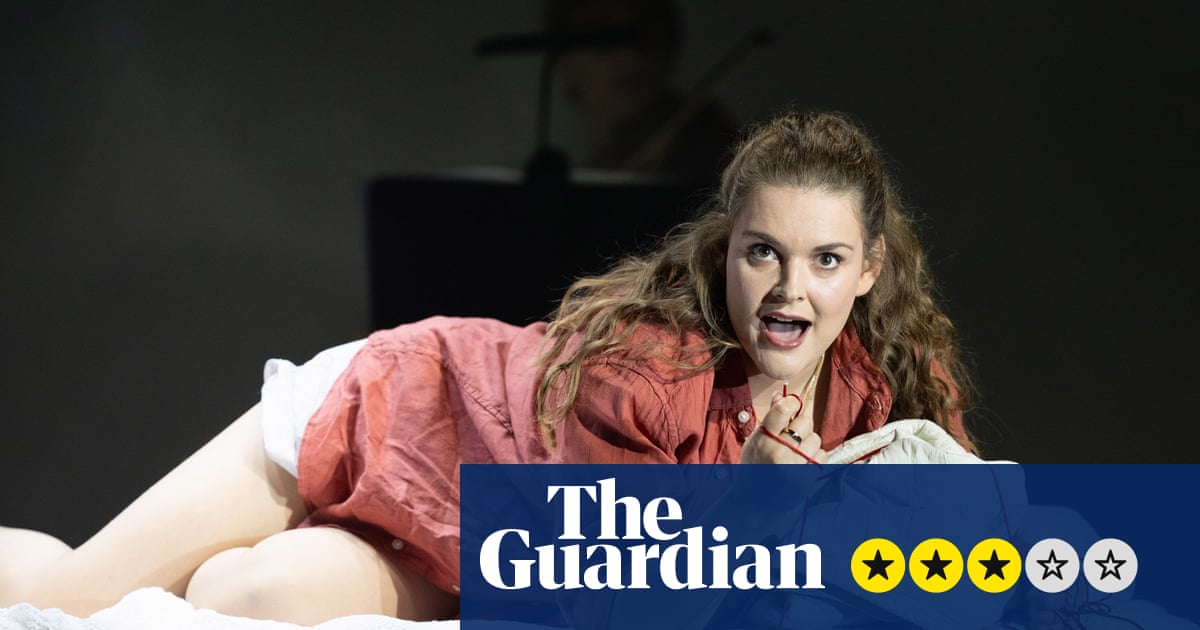
Langer’s mini-opera is essentially a monologue, sung persuasively here by Jessica Cale, her powerful soprano diamond-bright. Anna Morrissey’s production, though, has six people on stage: abandonment feels like something active as well as passive. It begins with Theseus leaving, disentangling himself from both the sleeping Ariadne and the red thread that links them, spooling from a heap on the floor – it’s as if he got back from the labyrinth the night before. When Ariadne wakes he’s still there, pacing in the shadows or turning her bed on its rotating platform.
(暂无翻译) (暂无翻译) (暂无翻译) (暂无翻译)
Langer writes, captivatingly, for four instruments: oboe, violin, viola and cello, playing without a conductor. They combine in high sonorities to reinforce the voice in a way that suggests the play of light on waves. As for Ariadne, she stands on that bed gazing out to sea as Joseph Hornsby’s lighting emulates the sun reflecting off water. The ending, in which Ariadne appears to sew the red thread through her skin, looked fiddly and took a bit too much of Cale’s concentration, even if the concept was good.
(暂无翻译) (暂无翻译) (暂无翻译) (暂无翻译)
We’re in a strikingly different world for Rebecca Meltzer’s staging of Dido and Aeneas. While Alex Berry’s set of black rocks and huge frosted glass panels could work for any operatic myth, Meltzer gives the action a playground dynamic (Purcell’s opera was performed early on by the pupils of a girls’ school). Everyone but Dido is in a stylised mishmash of charcoal blazers and pleated skirts, including the men; the look is somewhere between form room and a Thom Browne catwalk show. Lydia Shariff’s Sorceress has the body language of a year eight queen bee, while Isabelle Atkinson’s Belinda, Dido’s frenemy, puts on tiny sunglasses, reminiscent of Coraline’s black-button eyes, to become one of the witches. Dido is gaslit and bullied into her downfall, with the whole chorus, perhaps even Michael Lafferty’s velvet-voiced Aeneas, being complicit.
(暂无翻译) (暂无翻译) (暂无翻译) (暂无翻译) (暂无翻译)
In the pit, Alex Robinson directs the orchestra from the harpsichord with some imaginative touches that are slightly outweighed by steady tempos. Meltzer provides strong movement and it’s a compelling staging – but, despite Samantha Price’s expressive singing in the title role, something is missing. With Dido a victim from the start, there is little sense of a queen – and, by extension, her realm – being brought low by the collision between human passion and the whim of the gods. And that, surely, is the stuff myth is made of.
(暂无翻译) (暂无翻译) (暂无翻译) (暂无翻译)
仅供学习使用,如有侵权请联系删除 · 查看原文