Are the French police the most violent in the EU?
0 / 63
English
中文
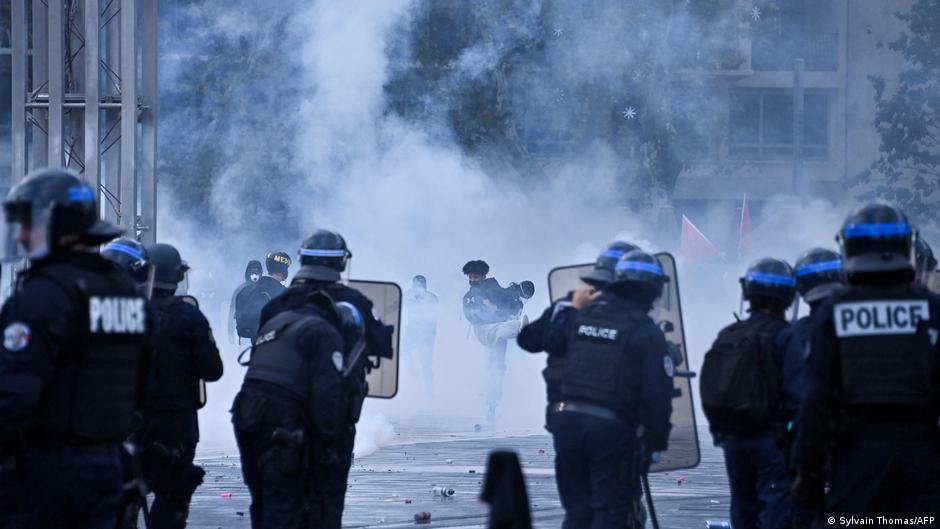
As protests continue in France, the French police are under scrutiny after new allegations of police brutality. The force has a bigger arsenal than most in Europe.
(暂无翻译) (暂无翻译)
Videos of alleged police violence are going viral on French social media as a wave of protests grips France. One video shows the police beating a man to the floor then dragging him away unconscious. Another shows an officer grabbing a young man from behind, seemingly unprovoked, and dragging him by the neck. Another shows a young woman being hauled off with a twisted arm, screaming in pain. These videos could not be independently verified.
(暂无翻译) (暂无翻译) (暂无翻译) (暂无翻译) (暂无翻译)
The French police have drawn renewed criticism from rights groups, not only because of their methods but also because of their use of stun grenades and rubber bullets. France has one of the most heavily armed police forces in Europe. During the student protests of the past weeks, several teenagers sustained life-changing injuries as a result: One had a hand blown off, one was blinded in one eye, another had his jaw broken.
(暂无翻译) (暂无翻译) (暂无翻译)
More than half a million people took to the streets in France on Saturday, most of whom protested peacefully, criticizing public sector cuts, the cost-of-living crisis and supporting students' demands for better conditions in classrooms.
(暂无翻译)
Rioters took advantage, burning buildings, looting stores and lobbing projectiles at the police, creating a difficult situation for the officers and other emergency services.
(暂无翻译)
The protests over the weekend followed a series of protests by high-school students, who barricaded school buildings to denounce a shortage of teachers and demand repairs to crumbling infrastructure.
(暂无翻译)
More protests will be happening this weekend, with the French government saying it will even deploy military forces.
(暂无翻译)
The French police have a bigger arsenal than most European countries. For instance, officers use the so-called LBD-40, a type of gun used to fire rubber bullets.
(暂无翻译) (暂无翻译)
Many countries, like the UK and Germany, mostly do not allow the use of rubber bullets in protests. In some European countries, like Spain, they are sometimes used but cause fewer injuries than in France.
(暂无翻译) (暂无翻译)
"It is not a French specificity. But there are guidelines. There must be a certain distance," Anastassia Tsoukala, an associate professor of criminology at the University of Paris-Sud, told DW. "Even if you try to respect the guidelines, people may move and then all of a sudden they may lose one eye. So it's extremely dangerous."
(暂无翻译) (暂无翻译) (暂无翻译) (暂无翻译) (暂无翻译)
Police in France routinely use tear gas, as do police in many other countries in Europe. In warfare, its use is actually forbidden under agreements like the Chemical Weapons Convention.
(暂无翻译) (暂无翻译)
What makes the French police stand out from other forces is its use of stun grenades.
(暂无翻译)
"These grenades contain a high level of explosive substances. So from this point of view, France is unique," said Tsoukala.
(暂无翻译) (暂无翻译)
Minister of the Interior Laurent Nunez insists that weapons used by the police are "non-lethal." However, some of the equipment used by the force is classified by France's own internal security code as "war material."
(暂无翻译) (暂无翻译)
To view this video please enable JavaScript, and consider upgrading to a web browser that supports HTML5 video The police's use of these weapons has received renewed criticism after it resulted in injuries during the protests.
(暂无翻译)
The teenager who lost use of an eye is suspected of being hit at close range with a rubber bullet from an LBD-40. "When we look at crowd control, it is clear that if we measure police brutality by the number of deaths amongst demonstrators or members of the crowd, and if we also measure it by the number of cases of maiming, the French police are the most brutal in the whole of the European Union," says Roche.
(暂无翻译) (暂无翻译)
He points to the political context to understand the French police's equipment and how it is used today.
(暂无翻译)
"The political authorities are free to decide on the police's equipment," the police expert says.
(暂无翻译)
"When LBDs were introduced into the [French] police force, they were intended for units like anti-organized crime units. This is the same weapon that is today used for crowd control. It gives an idea of how the way in which politicians in France think we can or should deal with political protest has evolved." Another difference between the French police and forces elsewhere is the methods.
(暂无翻译) (暂无翻译) (暂无翻译) (暂无翻译)
German police, for example, are supposed to try to avoid escalation. Roche compares how protestors were moved in Lützerath, Germany, in 2023 to the more aggressive methods in Sainte-Soline, France, in 2023.
(暂无翻译) (暂无翻译)
Both places saw environmental protests. "In Lützerath, dogs were used, there were some injuries but far fewer seriously injured people on both sides.
(暂无翻译) (暂无翻译)
In Sainte-Soline, the military police was sent in and used LBDs and grenades intensively. There were serious injuries amongst both police officers and demonstrators. Two protestors were left in a coma." According to international standards set by the United Nations, use of force by officers of the law "should be exceptional," in the case of "prevention of crime" or "lawful arrest."
(暂无翻译) (暂无翻译) (暂无翻译) (暂无翻译)
Any use of force should follow a principle of "proportionality," which means no more than necessary to achieve its objective. French Interior Minister Nunez has insisted in radio interviews that officers have largely respected this principle, which is also enshrined in French law, during the current protests.
(暂无翻译) (暂无翻译)
However, rights group Amnesty International describes the police response to the current protests as "disproportionate" and calls upon French authorities to "act upon their human rights obligations."
(暂无翻译)
The French branch of the League of Human Rights condemns the "violent repression" of the high school protest movement.
(暂无翻译)
DW contacted two police unions and the French Interior Ministry for comment, but none responded before time of publication.
(暂无翻译)
"It was very complicated to contain all the different groups," Interior Minister Nunez said in Marseille on Tuesday.
(暂无翻译)
"The police did a great job and there were a great number of crimes that were prevented thanks to their commitment." Experts are critical of the police's actions.
(暂无翻译) (暂无翻译)
"Public order is subordinated to human life and safety," Tsoukala said.
(暂无翻译)
"As a jurist I should say that this is a non-negotiable value." The French police have no independent watchdog, only an internal division called the IGPN (General Inspectorate of the National Police) that can investigate when problems occur.
(暂无翻译) (暂无翻译)
The IGPN says it has opened at least 40 cases since the beginning of the latest protests. Countries like the UK and Denmark investigate incidents differently, with independent watchdogs.
(暂无翻译) (暂无翻译)
However, Tsoukala criticizes leniency and a lack of transparency across Europe when incidents with the police occur. "They are acquitted or they receive extremely light penalties," she said.
(暂无翻译) (暂无翻译)
"And I'm afraid this is the standard method to deal with police brutality cases across Europe."
(暂无翻译)
仅供学习使用,如有侵权请联系删除 · 查看原文