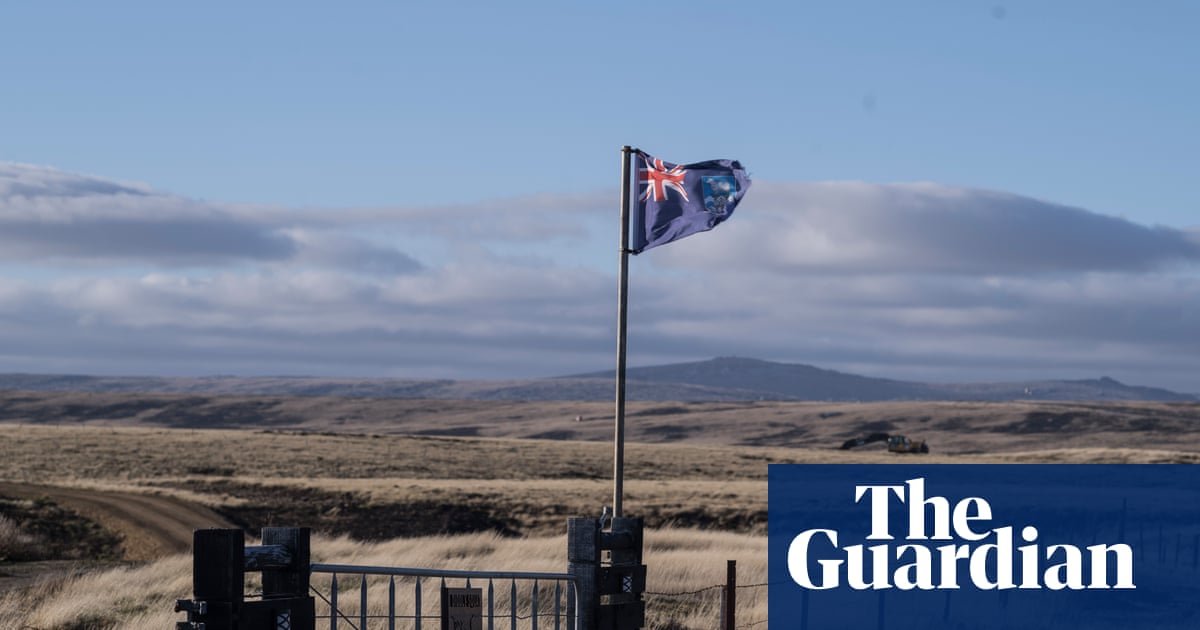
‘4,000 people minding our own business’: four decades on, Falklands again face a hostile Argentina
0 / 122
English
中文
A dozen local people and a uniformed military police officer (“Do you mind if I sit in?”) took their seats at the back of the handsome wood-panelled courtroom that doubles as the Falkland Islands’ legislative assembly. Outside, it was a typically blowy early evening. It may nominally be spring in the south Atlantic, but Stanley harbour, with its dark grey water speckled with historical shipwrecks, was a cauldron of swells and churn.
(暂无翻译) (暂无翻译) (暂无翻译)
Six of the assembly’s eight members – five men, one woman – waited patiently at a row of desks and microphones. The heating had been turned up to just short of uncomfortable. Behind them, a portrait of King Charles. From the other walls, dusty photographs of governors, of varying popularity, gazed disinterestedly at the scene.
(暂无翻译) (暂无翻译) (暂无翻译) (暂无翻译)
Proceedings started at the raised hand of a bored-looking young man wearing headphones in the corner. He was transmitting the question and answer session via radio across the dozen or so inhabited islands that make up the 778-strong archipelago.
(暂无翻译) (暂无翻译)
It was not clear how many of the Falklands’ 3,600 residents were listening in from their farm houses out in the diddle-dee shrub that coats much of the islands, or in the front rooms of Port Stanley’s white clapboard cottages with the pretty coloured roofs; likely not on a par with the number who learned 44 years ago from the Falkland Islands broadcasting station that their lands had been invaded.
(暂无翻译)
“There’s no turning back, we can expect them by dawn,” the governor, Rex Hunt, had said then.
(暂无翻译)
But for those who did tune in on Monday evening, there was much to dwell on. Not so much the answers about the local internet contract or the consultation on the contentious plan for a salmon farm.
(暂无翻译) (暂无翻译)
“I have another one for you,” piped up one enthusiastic quizzer with a heavy local accent, a West Country burr with a slight antipodean lift. That intervention prompted a little shuffling of tired bums. But a rather more significant announcement was to come.
(暂无翻译) (暂无翻译) (暂无翻译)
Lewis Clifton, an assembly member who can date his family’s residence on the Falklands to the late 1870s, advised the islanders that an unprecedented economic war was being waged against them – a community no bigger than an English village – by a country of 46 million people.
(暂无翻译)
“I am concerned that the level of Argentinian thrust this time has been at a different level,” Clifton said. “Perhaps a more vehement and belligerent tone than [seen since] 1982, because it has the potential to threaten our very economic development.” Facing a downturn in his domestic polling and with an upcoming election, Argentina’s president, Javier Milei, has legislated to criminalise companies and individuals involved in the Falklands’ nascent oil industry, and suggested the fisheries industry on which it currently relies for its prosperity could be next.
(暂无翻译) (暂无翻译)
The British forces capability at Mount Pleasant airbase – 1,800 personnel there and on Ascension island, four typhoon jets, a ground-based air defence system and with HMS Medway patrolling the waters – makes a military threat from Argentina largely hypothetical.
(暂无翻译)
But Buenos Aires has launched a full spectrum attack of another sort. In response this week, Andy Burnham and his foreign secretary, Ed Miliband, restated the UK’s solidarity with the islanders’ desire to remain British, and promised legislation that might offer some protection against the financial damage imposed by Argentina’s economic sanctions.
(暂无翻译) (暂无翻译)
Interpol received Foreign Office representations suggesting they reject an Argentinian request for arrests relating to the dispute. For the islanders, it was a welcome show of muscularity.
(暂无翻译) (暂无翻译)
They have never felt entirely confident in the spine of those in power back on the homeland. It was arguably the indifference of Westminster that led Argentina to launch its invasion in the first place back in 1982. “I have never trusted the Foreign Office and I have been proven right,” said Norma Edwards, 84, whose husband, Roger, 80, a former Royal Marine, was attached to the SAS in the 1982 conflict.
(暂无翻译) (暂无翻译) (暂无翻译)
“Catching up time,” said Clifton, of what he saw as a belated toughness from London this week. But things remain precarious. The Falkland Islands might be described as a British success story.
(暂无翻译) (暂无翻译) (暂无翻译)
Four decades ago, there were 1,800 inhabitants, and its tiny wool-centric economy, 300 miles (480km) east of mainland South America, was dependent on UK government handouts. Today the population, growing at 3% year-on-year in recent times, includes about 70 different nationalities, attracted by the 26% top rate of tax, good pay and opportunities in a growing and entirely self-reliant economy.
(暂无翻译) (暂无翻译)
There are Zimbabweans who came to de-mine after the war.
(暂无翻译)
Construction workers from South Africa who came to rebuild. Chileans who found something they liked after taking a Latam Airlines flight. The largest minority group is the Filipinos, who came to work in social care and the service industry in the late 1980s and 90s. Working behind the bar at Groovy’s, a Nepalese waiter said he had come from Dubai.
(暂无翻译) (暂无翻译) (暂无翻译) (暂无翻译)
The money was better in the Falklands, he said, and “the people are nicer”. “The locals start at Deano’s bar, then it’s the Victory bar and here – then it is the Globe, for dancing,” he said with a smile. “After that they go to house parties.” Such has been the Falklands’ success in attracting people that a permanent residency scheme, capped at 90 people a year, has been frozen for 12 months. The islands, for all their challenges, are somewhere people want to be.
(暂无翻译) (暂无翻译) (暂无翻译) (暂无翻译)
All of this had been made possible because of squid, said John Barton, chair of the fishing companies association. “It has been transformational,” he said.
(暂无翻译) (暂无翻译)
In 1986, the UK allowed the Falklands to establish a 200-nautical-mile exclusive fishing zone in which those wanting to operate had to be licensed by the islands’ government. Licences sold to fleets of Spanish, Korean and Taiwanese “jiggers” have delivered major revenues, but the locals are increasingly running the vessels too.
(暂无翻译) (暂无翻译)
The islands’ gross domestic production per capita soared as a result, from about £2,000 in 1982 to £85,000 in 2025, putting the islands sixth in the world league table, just behind Norway. The tourism industry is also going strong, with 75,000 or more people spilling out of cruise ships every year at Stanley port, but that is at best a nice addition.
(暂无翻译) (暂无翻译)
James Wallace, 41, is chief executive of Fortuna, the largest fishing company on the island. It is a growing operation, which last year acquired Cornwall’s oldest fishing business, the Ocean Fish Group.
(暂无翻译) (暂无翻译)
But he is diversifying his business for a reason. The squid populations in the Falklands waters, on which his company and the islands rely, are hugely variable and it is clear that “catches are declining”, he said. “We have commissioned a bunch of inshore work to see what is happening but the answer is that we don’t yet know,” he said.
(暂无翻译) (暂无翻译) (暂无翻译)
But there is another natural resource on which the islanders’ hopes are pinned. About 136 miles north of the Falkland Islands, work is continuing at pace on the Sea Lion oil project led by Israeli firm Navitas and its British partner, Rockhopper Exploration. Independent estimates suggest the offshore oil field could triple the Falkland Islands’ GDP and deliver a Norway-style sovereign wealth fund.
(暂无翻译) (暂无翻译) (暂无翻译)
The companies involved remain confident that drilling will commence within months.
(暂无翻译)
A new jetty is busy with activity. But the impact of Argentinian pressure cannot be discounted. Two major contractors recently pulled out of the project. Andrea Clausen, as chief executive of the Falklands government, its top civil servant, works from a building on Thatcher Drive. Her office is opposite the room where Brig Gen Mario Menéndez signed Argentina’s letter of surrender on 14 June 1982.
(暂无翻译) (暂无翻译) (暂无翻译) (暂无翻译) (暂无翻译)
The letter remains on the wall. Clausen was 10 at the time of the invasion and remembers the Argentinian solders’ arrival. She also recalls cowering with her family in their home in Goose Green, 60 miles west of Stanley, as the British Harrier jets came in with their cluster bombs.
(暂无翻译) (暂无翻译) (暂无翻译)
“Even now I struggle to cope with the sound of fast jets,” she said. Clausen sees trauma throughout the islands. “I guess, some extreme behaviour,” she said.
(暂无翻译) (暂无翻译) (暂无翻译)
“Anger, aggression on certain political subjects.” She is evidently frustrated by the recent Argentinian actions. “The Falklands has since [19]82 ensured that we are financially independent – save for defence,” she said. “We had no money in 82 and we never want to be in that position again.” The oil is their insurance, she suggested.
(暂无翻译) (暂无翻译) (暂无翻译)
“I like to think that better people will de-escalate this because, honestly, we are 4,000 people minding our own business, we have a history deeper and older than theirs.” There are cycles to Argentinian bellicosity. The opportunistic but ill-fated invasion ordered by Argentina’s dictator general Leopoldo Galtieri, leading to the death of 649 Argentinians and 255 British military personnel, along with three islanders, has cast a pall over Argentinian-UK relations ever since.
(暂无翻译) (暂无翻译)
But at times, notably in the 1990s, Buenos Aires adopted a hearts-and-minds approach to the islanders, sending videos of the animated series Pingu to their children. Such kindness has tended to evaporate away, though, when an Argentinian government is losing public support at home, as Milei is experiencing now.
(暂无翻译) (暂无翻译)
But if any one attribute sums up the islanders, it is resilience, said Dot Gould, an assembly member who owns Pebble, a 20-mile long island north-west of the Falklands. She and her husband share the island with a couple who run a lodge, 5,000 sheep, 100 cattle, a load of spectacular wildlife, but not much else.
(暂无翻译) (暂无翻译)
Rampaging around the undulating terrain in her 4x4 vehicle, avoiding colonies of Rockhopper and Gentoo penguins, Gould points out the scattered remains of an Argentinian fighter jet and the graves of two of the airmen killed during battle. As a child on Pebble, she used to play with the parachutes left by the Argentinians, using them as sails for a go-kart.
(暂无翻译) (暂无翻译)
“I think, since 1982, this is probably the most serious it’s been for us,” she said. “How effective they will be, we don’t know yet … it’s almost two fingers up: we’ll get on with it, we have to.” But there is much that they want to do.
(暂无翻译) (暂无翻译)
The islands are dependent on a narrow range of freight links from the UK and South America for much of their fresh produce. Any glitch, and peculiar shortages can emerge.
(暂无翻译) (暂无翻译)
There was a period without milk. A time without beer.
(暂无翻译) (暂无翻译)
During one cherry tomato shortage, which saw their price shoot up, the main supermarket opted to cut them in half and sell them like that to spread the joy. A sorry-looking cabbage will set you back £8 at the West Store on the front. The local newspaper is the Penguin News (“This one’s not for Penguin News but …” is the traditional opening when disseminating islands gossip). But Facebook is the key means of communication. “Grown men and women use Snapchat like teenagers, often to arrange their extramarital affairs,” said one local.
(暂无翻译) (暂无翻译) (暂无翻译) (暂无翻译) (暂无翻译)
Other peculiarities include the Falklands government paying for children from the age of 16 to complete their secondary and university education in the UK. The size of the islands’ population makes it impractical to offer such levels of education at home, said Sarah Stannard, the islands’ director of education. But if the oil money comes online, she would rebuild the primary school. Children from the countryside – it is known locally as “camp” – are offered board in Stanley, although there are also peripatetic teachers and lessons done on the telephone.
(暂无翻译) (暂无翻译) (暂无翻译) (暂无翻译)
The children grow up quickly here, and tend to be keen to broaden their horizons. Oliver Lee, 15, was keen to join the merchant navy.
(暂无翻译) (暂无翻译)
“I would like to see other places,” he said. “The Mediterranean, hotter places basically.” Layla-May Vatemanu, 14, said: “A lot of the boys especially in my class do a lot of sport.
(暂无翻译) (暂无翻译)
Our [friendship group] doesn’t have a lot to do.” There are no bus services anywhere, and the more distant parts of the islands are only accessible via boat or the Falkland government’s twin-engine aircraft service. On a landmass half the size of Wales, there is only one cashpoint. Touch rugby – rather than full-contact rugby – is played, in part because the islands’ hospital does not have the capability to deal with complex injuries. Much of the health budget goes on medi-evacs to South America. Yet, for all that, most of the children who leave at 16 do return.
(暂无翻译) (暂无翻译) (暂无翻译) (暂无翻译) (暂无翻译)
All places are shaped by their history and geography, but some have more history and geography than others. “We are British with a twist,” said Stacy Bragger, a former journalist who represents the Stanley constituency in the assembly.
(暂无翻译) (暂无翻译)
“We have our own identity. If you were to ask what are the traits of a Falkland islander – resourcefulness, resilience, making do. Because if something breaks you can’t just go down the road.
(暂无翻译) (暂无翻译) (暂无翻译)
You have to make do. That’s our version of Britishness.” The islanders also have long memories.
(暂无翻译) (暂无翻译)
“I used to read the Guardian when I was a good deal younger,” said Mike Summers, 73, who sits on the board of the local chamber of commerce. “But I stopped reading it in 1982 when [the editor] Peter Preston just fucked me off so much. He was: ‘Oh well they are a long way away and there is only a few of them – so why don’t we just sell them?’” On the Argentinian rhetoric, Summers added: “There are a lot of people who still suffer effects from the war – PTSD among the older people. I bumped into someone at the supermarket the other day who I have known for ever. She said: ‘Oh, I’m wondering if I should sell my house and move away.
(暂无翻译) (暂无翻译) (暂无翻译) (暂无翻译) (暂无翻译)
The Argies are going to invade again.’ It seriously affects some people and it is cruel actually.” Roxy King-Clarke, 40, describes herself as the Falklands’ biggest influencer, with about 60,000 followers. She picked up a major following when posting in response to the Argentinian men’s football team brandishing a “Las Malvinas son Argentinas” [The Malvinas are Argentinian] banner at the World Cup. She is regularly subjected to abuse for her posts. “The most common insults are to call us pirates, usurpers and colonisers,” she said.
(暂无翻译) (暂无翻译) (暂无翻译) (暂无翻译)
“It’s a bizarre thing to be on the receiving end of it all as they speak like we’ve just tipped up here. I can trace my family back to my earliest ancestor arriving here in 1842.” Her generation too, she suggests, have taken lessons from what happened four decades ago. King-Clarke said she would take a “hard line” to avoid any misinterpretation. “We need to learn from history,” she said, “and not make the same mistakes.”
(暂无翻译) (暂无翻译) (暂无翻译) (暂无翻译)
仅供学习使用,如有侵权请联系删除 · 查看原文